

There will be no lasting peace either in the heart of individuals or in social customs until death is outlawed.
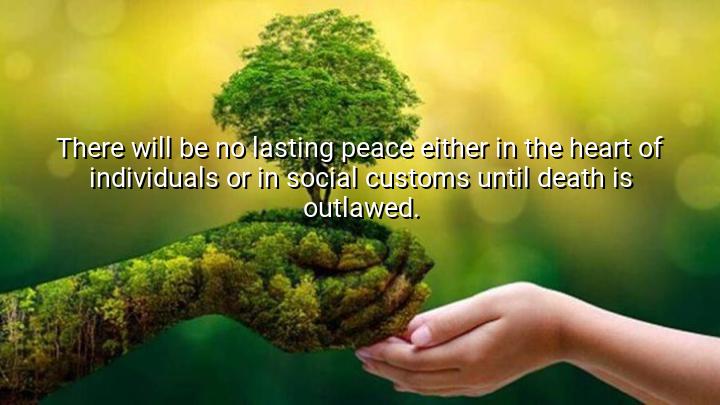




The quote "There will be no lasting peace either in the heart of individuals or in social customs until death is outlawed." by Albert Camus reflects his deep philosophical view on the nature of violence, death, and peace. Camus suggests that true peace—both on a personal level and within society—cannot be achieved unless we abolish the concept of death as a form of punishment, retribution, or even a natural end. He argues that as long as death is seen as a solution to conflicts or problems, whether in the form of capital punishment or war, there can be no real peace in the hearts of individuals or in social structures.
In this statement, Camus critiques the widespread acceptance of death in human society, whether it is through violent acts, punishment, or the inevitability of natural death. He emphasizes that violence—whether physical or emotional—leads to a cycle of suffering that obstructs the path to true peace. By outlawing death, Camus imagines a world where people would be forced to confront suffering in non-violent ways, leading to more profound understanding, compassion, and human connection.
The origin of this quote lies in Camus’s broader body of work, particularly his existentialist philosophy. Camus often explored themes of absurdity, death, and the human condition, emphasizing the absurdity of seeking meaning in a world where death is inevitable. His work, including "The Myth of Sisyphus" and "The Plague", grapples with the idea of living a meaningful life in the face of death and suffering, suggesting that peace can only come when we choose to transcend the destructive forces of violence and death.
Ultimately, this quote speaks to Camus’s belief that humanity must rethink its relationship with death and violence if it is to achieve lasting peace. He calls for a radical shift in social customs and personal attitudes, urging society to embrace life-affirming practices that reject the need for death as a resolution to conflict or suffering. Through this lens, Camus envisions a world where peace is not just the absence of war but the deep reconciliation of humanity with life, compassion, and the absence of death-driven decisions.

AAdministratorAdministrator
Welcome, honored guests. Please leave a comment, we will respond soon