

There was no respect for youth when I was young, and now that I am old, there is no respect for age, I missed it coming and going.
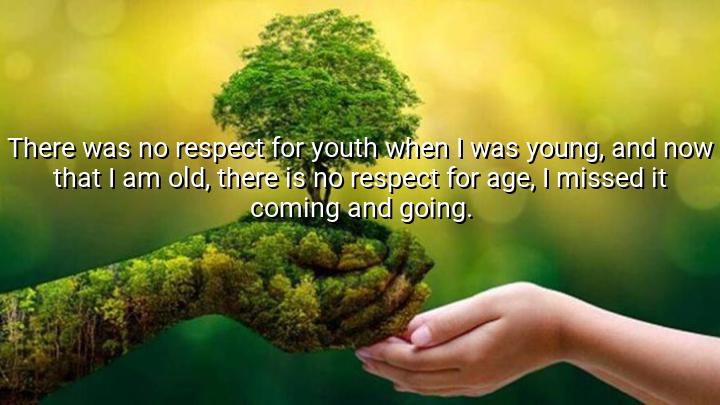




J.B. Priestley’s quote, “There was no respect for youth when I was young, and now that I am old, there is no respect for age, I missed it coming and going,” reflects his sense of frustration with the generational divide and the lack of respect he perceives for both the young and the old. Priestley highlights how societal values regarding age have shifted over time, suggesting that when he was younger, the wisdom and experiences of older generations were not valued, and now, in his old age, youth seems to be revered while the elderly are overlooked. His statement underscores a feeling of being caught between two stages of life, neither of which is afforded the respect it deserves.
Priestley’s commentary about respect points to a broader societal issue of how different age groups are perceived and treated. His quote is an observation on the lack of appreciation for the elderly and the youth, both of whom can be vital to society in different ways. The underlying message is that society tends to overlook the potential and value of people at either end of the age spectrum. In his case, he feels that both his younger and older selves were dismissed, a feeling of alienation across time.
The origin of the quote can be traced to Priestley’s lifelong interest in social critique and human behavior. Known for his works of drama and novels, Priestley often explored the complexities of society and class dynamics. This quote is in line with his broader themes, where he questioned societal norms and the treatment of different groups within the population. Priestley, writing in the mid-20th century, was particularly critical of social inequality and division, including how the elderly and younger generations were often marginalized.
In a broader context, Priestley’s quote speaks to the cyclical nature of social issues and the ways in which ageism manifests in both directions. It reflects the reality that respect, in many cultures, is often conditional, based on external factors like youth, appearance, or productivity, rather than intrinsic value or wisdom. Priestley’s reflection serves as a reminder that respect should not be limited by age, and that all generations have something valuable to contribute.

AAdministratorAdministrator
Welcome, honored guests. Please leave a comment, we will respond soon