

There is no place where we can safely store worn-out reactors or their garbage. No place!
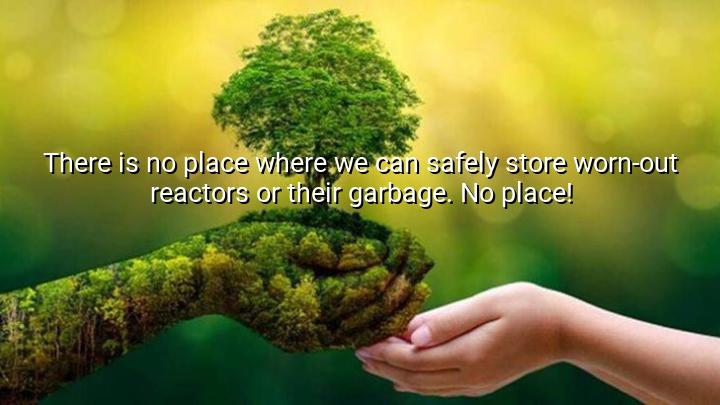




The quote “There is no place where we can safely store worn-out reactors or their garbage. No place!” by David R. Brower emphasizes the perils and long-term consequences of nuclear waste. Brower highlights that radioactive materials from nuclear reactors cannot be safely contained indefinitely, posing serious environmental and health risks. The quote underscores the urgency of addressing nuclear safety, waste management, and sustainable energy practices.
David R. Brower, an American environmentalist and the first executive director of the Sierra Club, was a leading advocate for conservation and environmental protection. This quote reflects his activism in raising awareness about the dangers of nuclear energy and its byproducts, warning that human attempts to contain nuclear waste are inherently limited and precarious. Brower’s work often focused on the long-term impacts of human activity on ecosystems and public safety.
The quote also illustrates a broader principle about responsible stewardship of technology and the environment. By emphasizing that there is no truly safe storage for nuclear waste, Brower highlights the need for caution, alternative energy sources, and preventive measures. It reminds society that technological advancements must be balanced with environmental responsibility and foresight to prevent irreversible harm.
Ultimately, Brower’s statement serves as a stark warning about the consequences of ignoring environmental limits. It encourages individuals, policymakers, and industries to prioritize safety, sustainability, and long-term planning, showing that human innovation must always consider ecological and societal impacts. His words reinforce the importance of proactive environmental protection in the face of potentially catastrophic risks.

AAdministratorAdministrator
Welcome, honored guests. Please leave a comment, we will respond soon