

There is no heaven or afterlife for broken-down computers; that is a fairy story for people afraid of the dark.
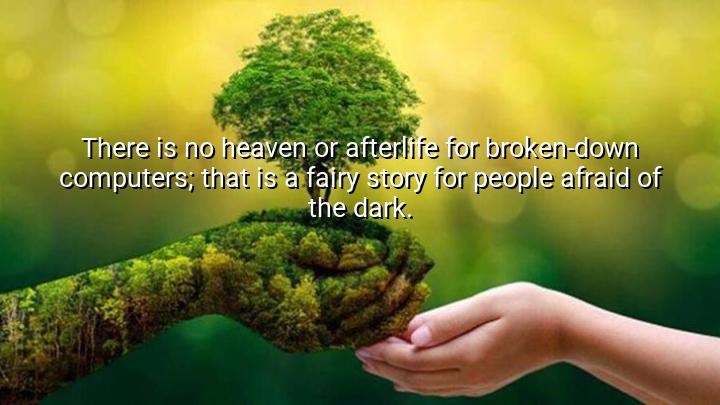




The quote, "There is no heaven or afterlife for broken-down computers; that is a fairy story for people afraid of the dark," by Stephen Hawking, reflects his scientific and rational view of the universe. Hawking, a renowned theoretical physicist, was known for his atheistic beliefs and emphasis on science over superstition. In this quote, he uses the metaphor of computers to illustrate the concept of death and afterlife, asserting that when a machine, like a computer, stops functioning, it doesn't have an afterlife or spiritual continuation—just as humans do not, in his view. He challenges the comforting idea of an afterlife, suggesting it is a myth created to ease the fear of death and the unknown.
The origin of this quote is rooted in Hawking's broader philosophical perspective, which combined his understanding of physics with his skeptical stance on religious beliefs. As a scientist, he believed that everything in the universe, including the nature of life and death, should be understood through empirical evidence and reason, not through faith-based or supernatural explanations. The comparison of computers with human existence highlights the inevitability of death and the finite nature of life, according to his worldview.
At its core, the quote emphasizes rationalism and scientific skepticism. Hawking suggests that the idea of an afterlife is a comforting fiction created by humans to avoid confronting the finality of death. By referencing computers, which function in a purely mechanical and materialistic way, he draws a parallel to the human experience, urging people to face the reality of mortality without resorting to superstition or fantasy.
The quote also underscores Hawking's belief in the importance of facing reality head-on, without the need for comforting stories about the unknown. Just as we accept the limitations of computers when they cease to function, Hawking argues, we must accept the limitations of our own existence and avoid being swayed by the fairy stories of religion. It’s a call to approach life with clarity, rooted in the understanding of science and reason rather than fear or myth.

AAdministratorAdministrator
Welcome, honored guests. Please leave a comment, we will respond soon