

There is danger in reckless change, but greater danger in blind conservatism.
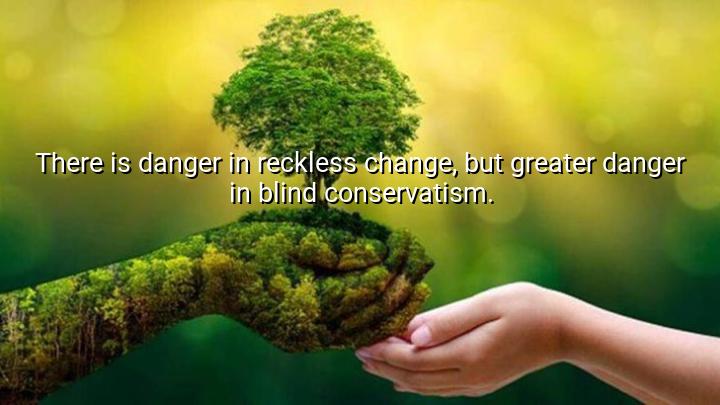




This quote by Henry George presents a balanced critique of two opposing forces in society: reckless change and blind conservatism. On one hand, George acknowledges that not all change is positive—when pursued without thoughtfulness or direction, it can lead to instability or unintended consequences. However, he argues that an even greater threat lies in resisting change altogether simply out of tradition or fear. This kind of blind conservatism, where people cling to the status quo regardless of its flaws, can block progress and perpetuate injustice.
The phrase "greater danger" signals George's belief that stagnation and refusal to adapt are more harmful in the long run than the risks associated with innovation. He viewed social reform as necessary, particularly when existing systems served only a privileged few while marginalizing the majority. George believed that meaningful improvement required a willingness to challenge entrenched norms, even if it meant discomfort or uncertainty.
The origin of this quote is rooted in Henry George’s work as a 19th-century economist and social philosopher, most notably in his influential book Progress and Poverty. George became known for his advocacy of the single tax on land value and his critique of economic inequality. His ideas inspired movements for land reform, tax justice, and broader economic fairness during the Gilded Age—a time of rapid industrialization and growing wealth disparity.
Ultimately, George’s message is a call for courageous reform guided by principle and reason, rather than reactionary impulses or blind loyalty to tradition. He invites us to examine our systems critically and to recognize that sometimes the most dangerous path is not the risk of change, but the refusal to evolve at all.

AAdministratorAdministrator
Welcome, honored guests. Please leave a comment, we will respond soon