

There can be no knowledge without emotion. We may be aware of a truth, yet until we have felt its force, it is not ours. To the cognition of the brain must be added the experience of the soul.
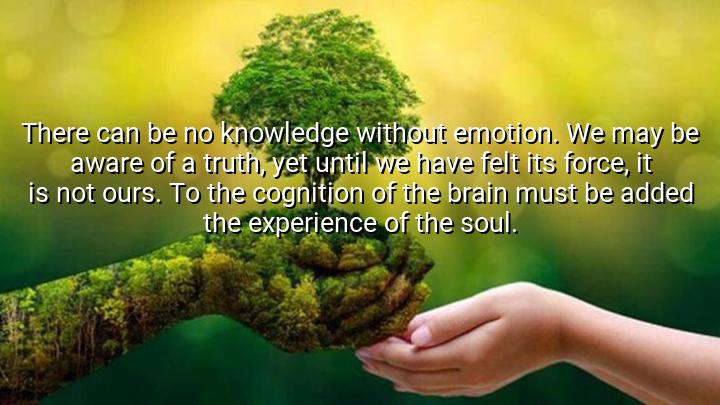




The quote by Arnold Bennett, “There can be no knowledge without emotion. We may be aware of a truth, yet until we have felt its force, it is not ours. To the cognition of the brain must be added the experience of the soul,” highlights the vital connection between intellectual understanding and emotional experience. Bennett suggests that simply knowing a fact or truth intellectually is not enough for it to become truly meaningful. Only when we feel the impact of that truth emotionally does it become a part of us, transforming from abstract knowledge into deep wisdom.
Arnold Bennett, an English novelist and essayist of the late 19th and early 20th centuries, often explored the complexities of human nature and the relationship between mind and heart. This quote reflects his belief in the importance of holistic understanding—the idea that true knowledge requires both reason and feeling. By emphasizing the “experience of the soul,” Bennett elevates emotional insight as a necessary counterpart to intellectual cognition.
The phrase “felt its force” indicates that emotions give knowledge its power and relevance. Without emotional engagement, knowledge remains distant and theoretical, lacking the ability to influence behavior or shape our inner lives. Bennett argues that cognition alone is insufficient; knowledge must be lived and internalized through emotional resonance.
Ultimately, this quote challenges us to integrate both mind and heart in our pursuit of understanding. It encourages a richer, more embodied approach to learning and truth—one that values the transformative potential of emotions to make knowledge truly our own. Bennett reminds us that knowledge without feeling is incomplete, and that wisdom arises from their union.

AAdministratorAdministrator
Welcome, honored guests. Please leave a comment, we will respond soon