

There are more clocks than ever - clocks on computers, on cell phones, on televisions, on any screen available, telling time to the digital second - but they all seem to matter less.
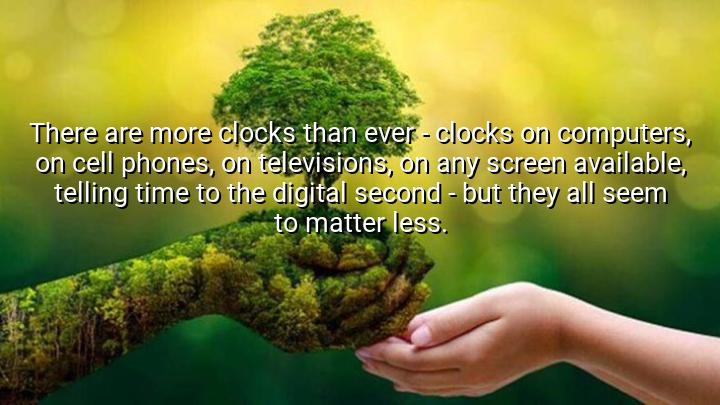




In this quote, Stacey D'Erasmo reflects on the abundance of clocks in modern life, pointing out how time is constantly measured and displayed on various devices such as computers, cell phones, televisions, and any available screen. Despite the fact that we are surrounded by clocks showing the time to the digital second, she suggests that time itself seems to hold less significance. The more accessible time becomes, the less it seems to affect how we experience or value it in our daily lives.
D'Erasmo’s observation touches on the idea that, in an age dominated by technology, time has become something we take for granted. With so many devices constantly showing us the time, we are no longer as attuned to its passing. Instead of using time as a tool for productivity or reflection, it often becomes a background feature of our digital environment, lessening its importance or impact on our actions and decisions.
The origin of this quote reflects D'Erasmo’s broader exploration of modern life and how technology shapes our perceptions and experiences. As a writer, she often delves into the psychological and social implications of living in a world increasingly driven by technology. Her statement serves as a critique of the overabundance of digital technology and its ability to make even something as fundamental as time feel less tangible or meaningful.
D'Erasmo's insight invites reflection on how technology has altered our relationship with time. While we are constantly aware of time through various devices, we may no longer feel the urgency or significance of it. This paradox, where time is more accessible yet less valued, raises questions about how our connection to time—and perhaps to life itself—has changed in the digital age.

AAdministratorAdministrator
Welcome, honored guests. Please leave a comment, we will respond soon