

There are, as is known, insects that die in the moment of fertilization. So it is with all joy: life's highest, most splendid moment of enjoyment is accompanied by death.
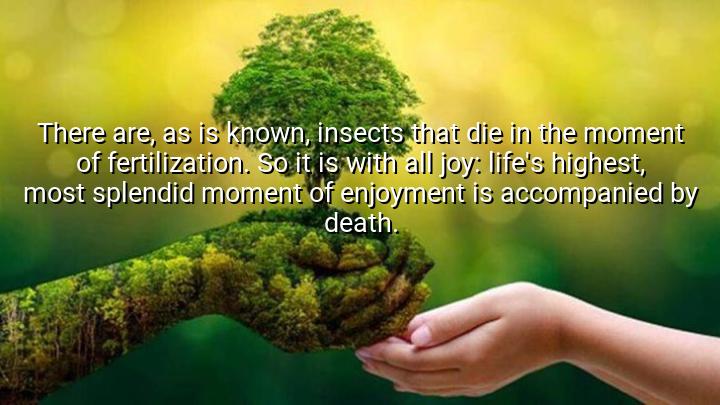




The quote by Søren Kierkegaard, a Danish philosopher and theologian, explores the paradoxical nature of joy and death. Kierkegaard compares the moment of joy to the life cycle of certain insects that die upon fertilization, suggesting that the highest and most splendid moments of enjoyment in life are often accompanied by the awareness or presence of death. This metaphor reflects Kierkegaard's belief that pleasure and suffering, life and death, are inseparable in the human experience, and that intense moments of happiness can also bring an inherent sense of loss or finality.
Kierkegaard is emphasizing the fleeting nature of joy. The idea that joy is often brief, and its most intense form is intertwined with the inevitability of death, challenges the notion of happiness as something purely fulfilling and permanent. In his view, the moment of greatest joy is often overshadowed by the knowledge that it is temporary, and that the ultimate end of life—death—remains a constant, underlying reality. The intensity of joy, then, is linked to the fleeting nature of existence.
The origin of this quote lies in Kierkegaard's broader existential and philosophical concerns with human existence, fear, anxiety, and the meaning of life. Known for his writings on faith and the human condition, Kierkegaard often explored the tension between existence and eternity, between joy and suffering. His works like Either/Or and Fear and Trembling grapple with the complexity of human emotions, showing that life is filled with contradictions, where the pursuit of happiness is always in tension with the reality of mortality.
In essence, Kierkegaard’s quote reminds us that joy and death are inseparable parts of the human experience. The most precious moments of life are often short-lived and bound by the reality of mortality. It calls for a deeper understanding of how life’s beauty and intensity are intertwined with its inevitable end, urging us to recognize that even in our highest moments, death is always present, shaping how we experience and appreciate the fleeting nature of life.

AAdministratorAdministrator
Welcome, honored guests. Please leave a comment, we will respond soon