

Love is all, it gives all, and it takes all.
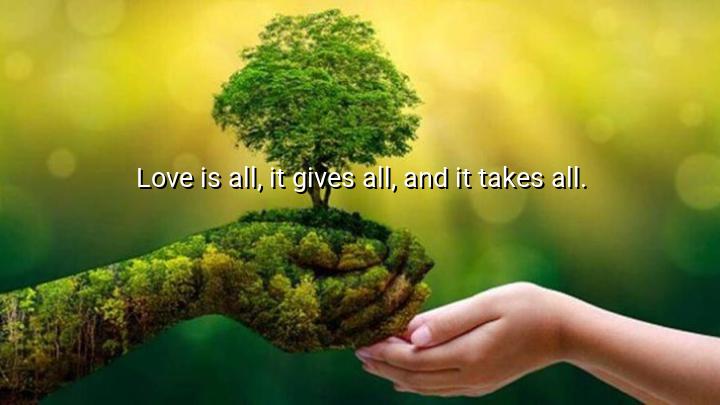




Søren Kierkegaard’s quote, "Love is all, it gives all, and it takes all," explores the profound and all-encompassing nature of love. As a 19th-century Danish philosopher, Kierkegaard was deeply interested in the complexities of human existence, particularly in relation to faith, passion, and individual responsibility. In this statement, he suggests that love is not just an emotion or feeling, but a force that can completely shape and define a person’s life. Love is presented as a central, all-powerful force that dictates both the giving and the receiving in relationships.
By saying love "gives all," Kierkegaard emphasizes the selfless aspect of love—how it requires individuals to give everything of themselves, including their time, energy, and emotions. This could refer to the sacrifices one makes for the sake of another, whether in romantic relationships, familial bonds, or friendships. The idea is that love involves deep commitment and generosity, often demanding one's full attention and effort without expecting anything in return.
On the other hand, when Kierkegaard says love "takes all," he acknowledges the sometimes painful aspect of love. While love may provide fulfillment, it also exposes individuals to vulnerability, loss, and heartache. The process of loving someone can be all-consuming, and sometimes love requires personal sacrifices or forces people to confront their deepest fears and insecurities. It "takes all" in the sense that love can demand everything from us, sometimes in ways that challenge our comfort or sense of security.
Ultimately, Kierkegaard’s quote reflects the paradox of love—its ability to both elevate and challenge individuals. By stating that love is "all," "gives all," and "takes all," Kierkegaard is highlighting the transformative and totalizing power of love, one that can lead to personal growth and fulfillment, while also requiring vulnerability, sacrifice, and at times, loss. Love is portrayed as the defining force of human existence, one that is capable of both joy and pain, yet always fundamental to the human experience.

AAdministratorAdministrator
Welcome, honored guests. Please leave a comment, we will respond soon