

The trouble with our times is that the future is not what it used to be.
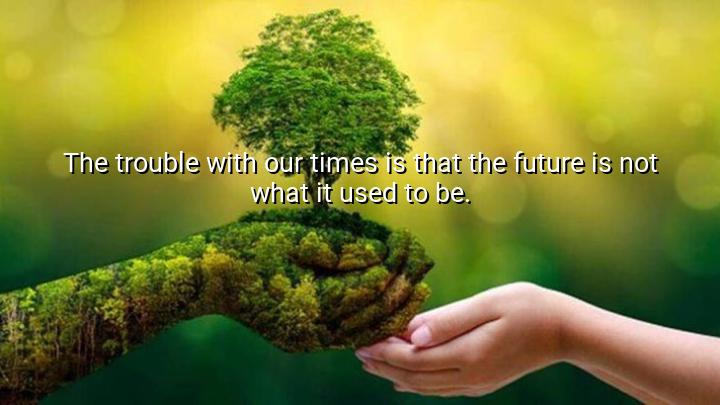




In this quote, Paul Valéry reflects on the changing nature of the future and how it no longer carries the same sense of certainty or predictability it once did. When Valéry says, "the future is not what it used to be," he suggests that the way people viewed the future in the past has shifted dramatically. Once seen as a time of progress, hope, and potential, the future now seems more uncertain, unpredictable, and perhaps even unsettling.
Valéry’s statement speaks to the broader context of social, technological, and political changes that have transformed the world in modern times. Where earlier generations might have imagined a future full of optimism and steady advancement, the present reality often feels chaotic and unstable. This could reflect a variety of factors, such as rapid technological advancements, political uncertainty, or environmental concerns, which have all contributed to a sense that the future is no longer as hopeful or well-defined as it once appeared.
The quote also touches on nostalgia and disillusionment, as it contrasts the idealized vision of the future from earlier times with the complexity and challenges we face today. Valéry may be lamenting how the promises of the past—whether in terms of scientific progress or societal development—seem increasingly out of reach, leaving people to question what the future holds.
Ultimately, Valéry’s quote captures the feeling of uncertainty that has come to define the modern worldview. It suggests that the future is no longer a continuation of past expectations, but something shaped by the unpredictable forces of contemporary life. It serves as a reflection on how changing circumstances can make the future feel less like a natural extension of progress and more like an unknown, with endless possibilities yet to be realized.

AAdministratorAdministrator
Welcome, honored guests. Please leave a comment, we will respond soon