

The future, like everything else, is not what it used to be.
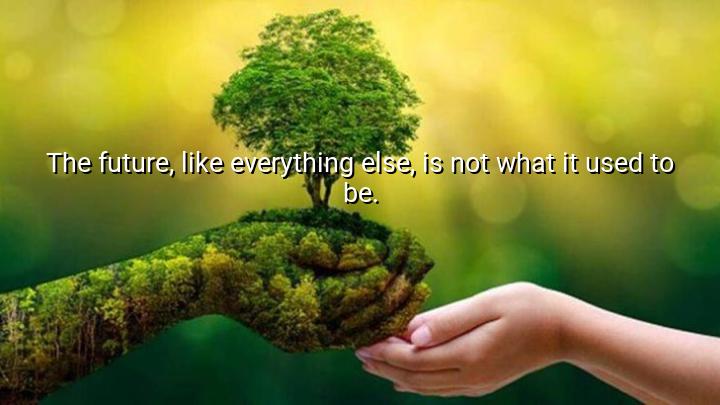




In this quote, Paul Valéry, a French poet and philosopher, reflects on the ever-changing nature of the future. By stating that "the future, like everything else, is not what it used to be," Valéry emphasizes the idea that the future is constantly evolving, influenced by new ideas, technologies, and societal shifts. This perspective challenges the traditional view of the future as a static or predictable concept, suggesting instead that it is as fluid and dynamic as the present.
Valéry’s words also point to the disconnection between past expectations and current realities. Historically, people have often envisioned the future in idealized terms, imagining progress in a linear or predictable manner. However, Valéry suggests that this notion is no longer valid, as the world is constantly changing, making it difficult to foresee or control the direction in which society is headed. This reflects a more modern understanding of time and progress, where the future is shaped by a multitude of unpredictable forces.
The quote can also be interpreted as a commentary on nostalgia and the human tendency to idealize the past. By contrasting the future with the past, Valéry touches on how people often look back with longing or dissatisfaction, comparing current realities with earlier times. This creates a sense of uncertainty about what lies ahead, as people feel disoriented by the pace of change and the gap between their expectations and actual outcomes.
Ultimately, Valéry’s statement serves as a reflection on the uncertainty and complexity of the future. It challenges the idea that we can fully understand or predict what is to come, urging a more open and flexible approach to change. The future, according to Valéry, is as elusive and unpredictable as any other aspect of life, and it is constantly being reshaped by forces beyond our control.

AAdministratorAdministrator
Welcome, honored guests. Please leave a comment, we will respond soon