

The profoundly 'atomic' character of the universe is visible in everyday experience, in raindrops and grains of sand, in the hosts of the living, and the multitude of stars; even in the ashes of the dead.
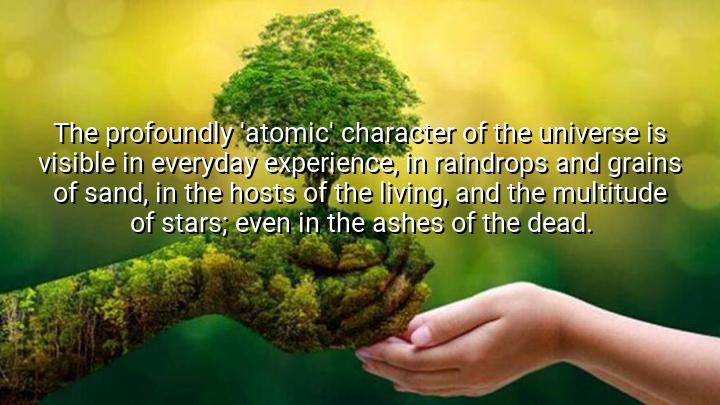




The quote "The profoundly 'atomic' character of the universe is visible in everyday experience, in raindrops and grains of sand, in the hosts of the living, and the multitude of stars; even in the ashes of the dead" by Pierre Teilhard de Chardin speaks to the idea that the fundamental nature of the universe is composed of tiny, indivisible particles—what we often refer to as atoms—which are present in all aspects of life, both living and non-living. Teilhard de Chardin suggests that everything in the universe, from the microscopic grains of sand to the vastness of stars and even the remains of the deceased, is interconnected through this atomic structure.
In this context, atomic refers to the smallest units of matter that form everything around us. Teilhard de Chardin, a French philosopher and Jesuit priest, was deeply influenced by both science and spirituality. He saw the universe as a dynamic, evolving system where everything, from the tiniest raindrop to the grand expanse of the cosmos, is made of the same basic building blocks. This atomic perspective links all forms of existence, suggesting that the same forces that shape the stars also shape the smallest parts of our daily lives.
Teilhard de Chardin’s philosophy sought to bridge science and spirituality, seeing the universe as a process of continual evolution, both materially and spiritually. His work explored how the atomic and material aspects of the world could be understood in a spiritual context. By emphasizing the atomic nature of both life and death, he highlights the interconnectedness of all things—alive and dead, large and small—through the fundamental building blocks of the universe.
Ultimately, Teilhard de Chardin’s quote encourages us to reflect on the profound unity of the universe, suggesting that we are all part of a greater whole. From the atoms that make up raindrops and sand to the farthest stars, everything in existence is connected by the same elemental forces, and even death is part of this ongoing cycle. This perspective invites us to see beauty and interconnectedness in both the microscopic and the cosmic aspects of life.

AAdministratorAdministrator
Welcome, honored guests. Please leave a comment, we will respond soon