

The paradox is that when we model future designs on past successes, we are inviting failure down the line; when we take into account past failures and anticipate potential new ways in which failure can occur, we are more likely to produce successful designs.
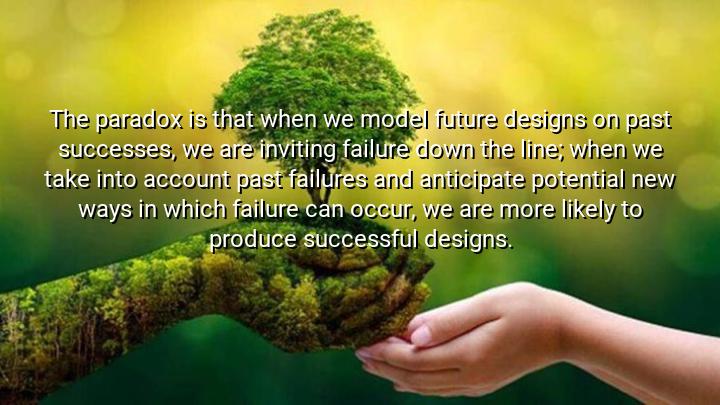




The quote by Henry Petroski—“The paradox is that when we model future designs on past successes, we are inviting failure down the line; when we take into account past failures and anticipate potential new ways in which failure can occur, we are more likely to produce successful designs”—reveals a fundamental truth about engineering, innovation, and learning from failure. Petroski highlights a paradox: relying too heavily on past successes may blind us to hidden flaws or new challenges, while actively analyzing failures equips us to anticipate problems and create more resilient designs.
This perspective encourages a shift from complacency to critical thinking. When designers and engineers only imitate what has worked before, they risk overlooking the evolving contexts, technologies, and environments that might render a previously successful solution ineffective. By contrast, a proactive understanding of past failures fosters a mindset of problem anticipation rather than mere problem solving. This makes innovation more robust, adaptive, and sustainable.
The quote reflects Petroski's broader philosophy that failure is not just an unfortunate outcome but a crucial teacher in the design process. As a professor of engineering and history, Petroski has long argued that studying the breakdown of bridges, structures, and systems reveals more about design integrity than only examining successes. In this way, engineering progress depends on learning from what has gone wrong rather than simply replicating what has gone right.
Originating from his extensive work in books like To Engineer Is Human and Success Through Failure, Petroski's insight speaks to professionals across disciplines. It applies not only to structural engineering, but also to business strategy, software design, and even personal growth. The key message is clear: real progress comes from acknowledging and preparing for what might go wrong—not just celebrating what once went right.

AAdministratorAdministrator
Welcome, honored guests. Please leave a comment, we will respond soon