

The only part of the conduct of any one, for which he is amenable to society, is that which concerns others. In the part which merely concerns himself, his independence is, of right, absolute. Over himself, over his own body and mind, the individual is sovereign.
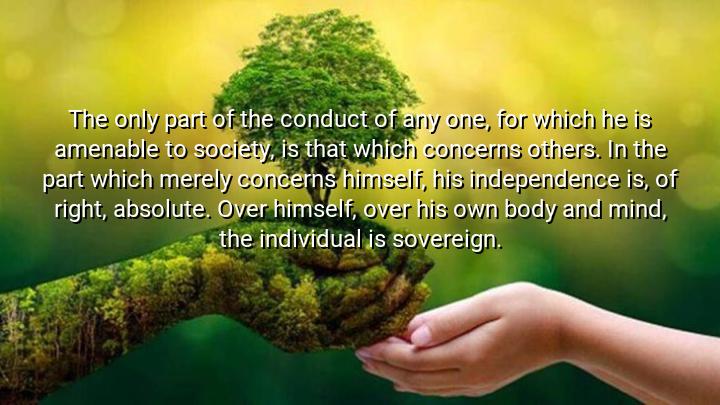




In this quote, John Stuart Mill outlines his philosophy of individual freedom and sovereignty. He asserts that the only aspect of a person's conduct that society has the right to regulate is that which affects others. This principle, often referred to as the harm principle, holds that individuals should be free to act according to their own will in matters that concern only themselves, as long as their actions do not harm others. Mill emphasizes that, in matters that are entirely personal, such as decisions about one's own body and mind, the individual holds absolute independence.
Mill's statement also introduces the idea that the individual is sovereign over their own life and choices, reinforcing the importance of personal autonomy. The concept of sovereignty in this context refers to the individual’s right to make decisions without interference from society, the government, or other individuals. This reflects Mill’s belief in the fundamental liberty of the person, where personal freedom is not only a right but an inherent part of being human.
The origin of this quote lies in Mill’s work "On Liberty", a key text in the liberal tradition. Written in 1859, the book explores the relationship between individual liberty and society, arguing for the protection of personal freedoms against the coercive power of government and societal norms. Mill’s ideas laid the groundwork for modern discussions about personal rights, the limits of government power, and the ethical balance between individual freedom and social responsibility.
Ultimately, Mill’s quote advocates for the sacredness of individual autonomy, suggesting that individuals should have the freedom to govern their own lives, free from external interference, as long as their actions do not harm others. It calls for a society that respects personal sovereignty and recognizes the boundaries between individual freedom and collective responsibility.

AAdministratorAdministrator
Welcome, honored guests. Please leave a comment, we will respond soon