

The person who has nothing for which he is willing to fight, nothing which is more important than his own personal safety, is a miserable creature and has no chance of being free unless made and kept so by the exertions of better men than himself.
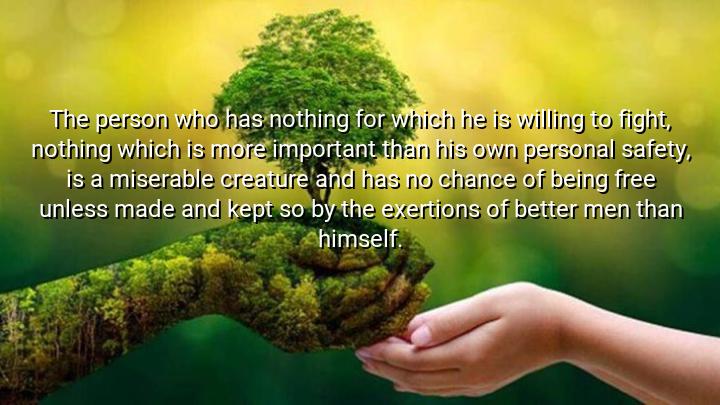




In this quote, John Stuart Mill argues that a person who has nothing for which they are willing to fight is essentially devoid of purpose and meaning in their life. Mill suggests that when personal safety is the only priority, and nothing else is considered more important, that person lives a miserable existence. Without something greater to fight for—whether it be freedom, justice, or a cause—they lack the deeper motivations that drive personal growth and fulfillment.
Mill goes on to say that such a person has "no chance of being free" unless others, who are driven by principle and selflessness, take action to protect their freedom. In this context, Mill is highlighting the idea that freedom requires both personal sacrifice and the collective efforts of those willing to defend and uphold it. A person who is unwilling to fight for what is right is reliant on others to ensure that their rights are maintained, making them, in Mill's view, incapable of true freedom without external intervention.
This quote also emphasizes Mill’s belief in the importance of values beyond self-interest. He argues that a meaningful life is driven by causes and ideals that transcend individual comfort. Self-sacrifice, whether for freedom or a greater moral purpose, is essential for both personal dignity and the protection of society's collective freedoms.
John Stuart Mill was a 19th-century philosopher and political economist, best known for his work on liberty, utilitarianism, and individual rights. This quote reflects his broader philosophical views, where he frequently explored the relationship between personal freedom and social responsibility. It is a call to not only value personal liberty but to actively defend it through commitment to important causes, even at the cost of personal safety.

AAdministratorAdministrator
Welcome, honored guests. Please leave a comment, we will respond soon