

The more I study religions the more I am convinced that man never worshipped anything but himself.
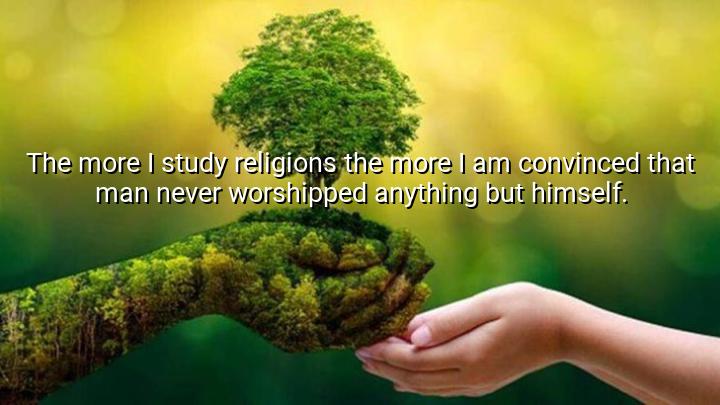




In this quote, Richard Burton, the famous British explorer and scholar, expresses a critical perspective on the nature of religion and human belief. Burton suggests that the more he explores different religions, the more he becomes convinced that humankind's worship is not directed at a divine being, but rather at an idealized or projected version of themselves. This statement challenges traditional views of religion as a means of worshipping an external deity and instead proposes that human beings are often worshipping their own creations—whether in the form of gods, ideals, or symbols that reflect human desires, values, and fears.
Burton’s quote suggests a psychological or sociological interpretation of religion, where worship is seen as a mirror of human self-identity and ego. In his view, religions may be expressions of human projection, with people creating gods or spirits that reflect their own needs, ambitions, and sense of self. This could be understood as a critique of how religion can be used to reinforce human self-importance or ego, where deities and divine beings are crafted in the image of human desires and aspirations rather than in the image of a true, otherworldly force.
Burton’s perspective aligns with a more atheistic or humanist critique of religion, which suggests that religious beliefs are often born from human psychology rather than external divine revelation. He implies that worship is an internal process of self-exaltation rather than a genuine acknowledgment of a transcendent power. This thought resonates with ideas in the philosophy of naturalism or humanism, where religion is seen as a construct born out of human experience and the need to understand and control the world.
The origin of this quote comes from Richard Burton, who was an explorer, linguist, and anthropologist. Burton was known for his extensive travels and his studies of various cultures and religions. His diverse background allowed him to engage critically with various religious practices and beliefs, and this quote reflects his growing skepticism towards organized religion as he observed its role in human society. His quote embodies his rationalist and scientific approach to understanding religion, where he questioned the true nature of worship and human motivations.

AAdministratorAdministrator
Welcome, honored guests. Please leave a comment, we will respond soon