

The history of science is rich in example of the fruitfulness of bringing two sets of techniques, two sets of ideas, developed in separate contexts for the pursuit of new truth, into touch with one another.
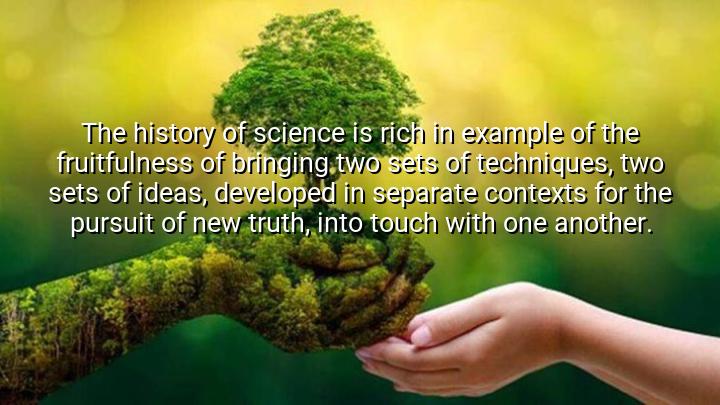




The quote by J. Robert Oppenheimer—“The history of science is rich in example of the fruitfulness of bringing two sets of techniques, two sets of ideas, developed in separate contexts for the pursuit of new truth, into touch with one another.”—reflects his recognition of the power of interdisciplinary thinking. Oppenheimer, best known as the scientific director of the Manhattan Project, understood that breakthroughs often arise when knowledge from different fields converges. By combining methods or insights from distinct traditions, scientists can generate discoveries that neither discipline could achieve alone.
The meaning of the quote lies in its emphasis on the collaborative and cumulative nature of scientific progress. Oppenheimer suggests that new truths emerge not just from deep specialization but from the fusion of perspectives. Examples throughout the history of science—such as the blending of physics and chemistry in atomic theory, or mathematics and astronomy in celestial mechanics—demonstrate how great advances occur at the intersection of disciplines. His words serve as both observation and encouragement: progress requires openness to ideas that may originate outside one’s own field.
The origin of this perspective is rooted in Oppenheimer’s own intellectual background. Trained in theoretical physics, he was known for his wide-ranging interests in literature, philosophy, and Eastern thought. As a leader during the Manhattan Project, he oversaw teams that combined expertise in physics, engineering, chemistry, and mathematics—a living example of his belief in the power of merging disciplines. His statement reflects not only his scientific insight but also his broader worldview: that innovation is inherently cross-pollinative.
In a broader sense, Oppenheimer’s words highlight a principle that remains true in today’s era of rapid discovery. Modern breakthroughs in fields like biotechnology, artificial intelligence, and quantum computing depend on combining diverse sets of techniques and ideas. His reminder that science thrives at the intersections remains a guiding truth for researchers and innovators. By pointing to the fruitfulness of such integration, Oppenheimer captures the essence of how human knowledge advances—through dialogue, synthesis, and the courage to bring separate worlds together.
Would you like me to also provide a few historical examples—such as Einstein’s use of mathematics in relativity or the merging of biology and chemistry in DNA research—that illustrate Oppenheimer’s point?

AAdministratorAdministrator
Welcome, honored guests. Please leave a comment, we will respond soon