

The guns and the bombs, the rockets and the warships, are all symbols of human failure.
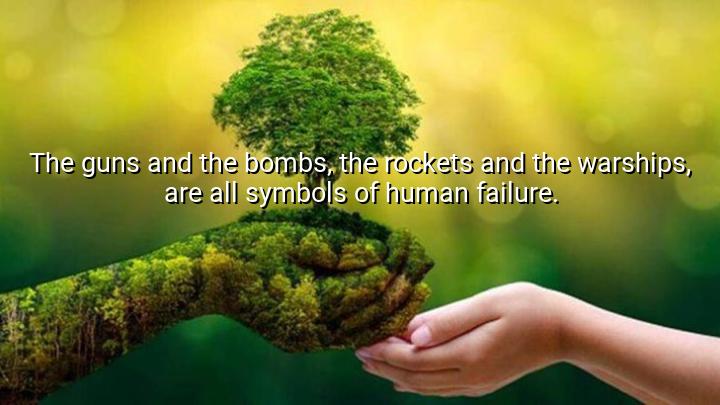




Lyndon B. Johnson’s quote, "The guns and the bombs, the rockets and the warships, are all symbols of human failure," critiques the destructive nature of war and the use of military technology as a reflection of humanity's inability to resolve conflicts through peaceful means. Johnson suggests that the creation and use of these weapons are not signs of strength or progress, but rather symbols of failure—failure to find diplomatic solutions and the failure to address the root causes of conflict. In this context, war and its instruments represent a breakdown in human values and communication.
The key word in this quote is failure—not just of political or military leadership, but of humanity as a whole to achieve lasting peace. Weapons of war, such as guns, bombs, rockets, and warships, are often seen as tools for defense or power. However, Johnson emphasizes that their very existence highlights humanity’s inability to find peaceful alternatives to resolving disputes. This perspective aligns with his broader political philosophy of seeking peaceful solutions through diplomacy and international cooperation.
Johnson’s quote also reflects his experience during the Vietnam War, a time when the United States was heavily involved in military conflicts abroad. The proliferation of military technology and the toll it took on both the U.S. and other nations likely shaped his view of war as a failure. The reference to these instruments of destruction as symbols speaks to their role in shaping the public perception of conflict, often overshadowing efforts toward peace.
The origin of this quote lies in Johnson’s presidency during a period marked by escalating military involvement in Vietnam. His stance against the heavy reliance on military power and his push for peace initiatives, such as the Civil Rights Act and Great Society programs, showed his belief in more constructive, non-violent methods to address societal issues. His criticism of military force as a symbol of human failure underscores his desire to prioritize diplomacy over warfare.

AAdministratorAdministrator
Welcome, honored guests. Please leave a comment, we will respond soon