

The great question is not whether you have failed, but whether you are content with failure.
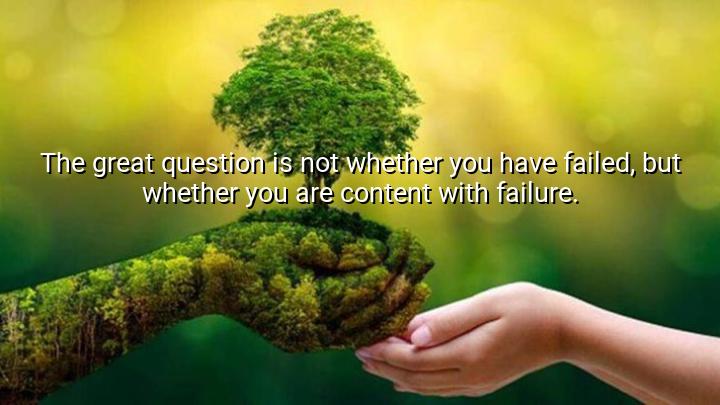




The quote by Laurence J. Peter focuses on the idea that failure itself is not as important as our response to it. Peter suggests that the real question in life is not about whether we encounter failure, but about whether we are content with it. He emphasizes that failure is an inevitable part of life, but it is our attitude towards it that determines our growth and success. If we accept failure without striving to improve, then we remain stagnant, but if we are dissatisfied with failure, we are motivated to learn and try again.
Peter’s quote encourages self-reflection and a deeper examination of our attitudes toward failure. It suggests that complacency with failure is a dangerous mindset, as it can prevent us from learning, growing, and pursuing our goals with determination. The question, then, is not about the failure itself but about our willingness to move beyond it and continue striving for better outcomes. If we are content with failing, we are unlikely to make progress.
Laurence J. Peter, a Canadian educator and author, is best known for his Peter Principle, which explores the idea that people in organizations are often promoted based on their performance in their current role, rather than their ability to perform in the role they are promoted to. His work often dealt with the challenges of human behavior and success in various systems. This quote reflects his interest in the dynamics of success and failure, urging us to constantly challenge ourselves rather than accepting defeat.
Ultimately, Peter’s quote serves as a reminder that failure is not the final destination. It is our response to failure—whether we are content with it or motivated to do better—that defines our path to growth and achievement. It encourages us to embrace failure as a lesson, not as an endpoint.

AAdministratorAdministrator
Welcome, honored guests. Please leave a comment, we will respond soon