

The first condition of education is being able to put someone to wholesome and meaningful work.
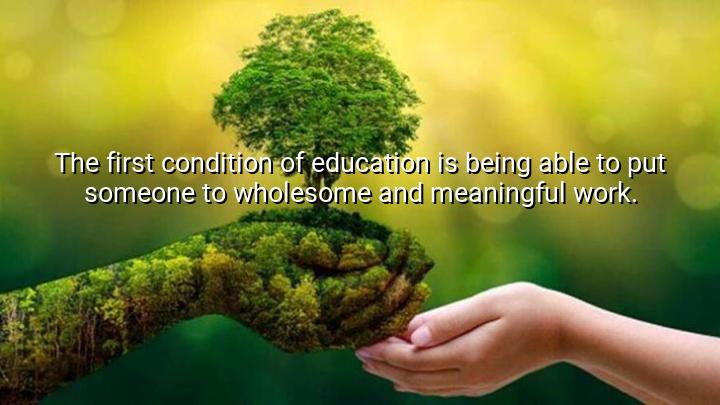




The quote by John Ruskin emphasizes the practical and moral dimensions of education. Ruskin suggests that true learning is not merely theoretical or academic, but should equip individuals to engage in wholesome and meaningful work. Education, in this view, is valuable when it prepares people to contribute positively to society and find purpose in their labor.
By highlighting the importance of work, Ruskin links education to practical skills, ethics, and the development of character. The idea is that knowledge alone is insufficient; individuals must also know how to apply what they learn in ways that are constructive, responsible, and beneficial to both themselves and their communities. This perspective encourages a balance between intellectual growth and practical competence.
The origin of this quote comes from John Ruskin (1819–1900), a prominent English art critic, social thinker, and philanthropist. Ruskin’s writings often explored the intersections of art, industry, and society, and he believed that education should cultivate not only the mind but also the moral and practical faculties of individuals. His work consistently emphasized that education should serve a larger social and ethical purpose.
Ultimately, this quote reminds us that the purpose of education extends beyond academic achievement. By preparing individuals for meaningful work, education nurtures responsibility, self-worth, and social contribution. It underscores the idea that learning is most effective when it connects knowledge with action, fostering both personal fulfillment and societal benefit.

AAdministratorAdministrator
Welcome, honored guests. Please leave a comment, we will respond soon