

The experience and behavior that gets labeled schizophrenic is a special strategy that a person invents in order to live in an unlivable situation.
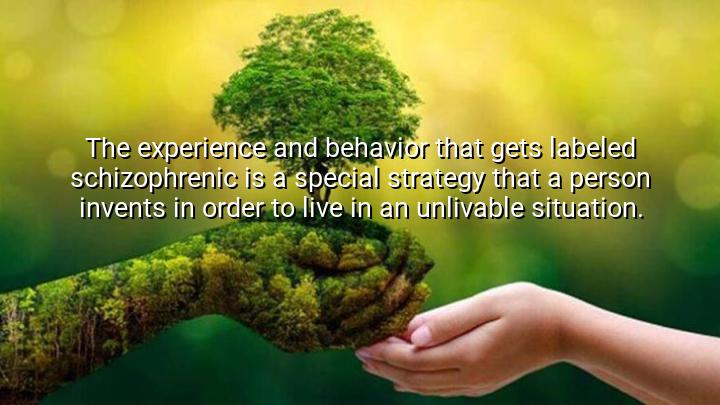




R. D. Laing’s quote, “The experience and behavior that gets labeled schizophrenic is a special strategy that a person invents in order to live in an unlivable situation,” offers a psychological perspective on mental illness and human coping mechanisms. Laing, a Scottish psychiatrist, suggests that what society often labels as schizophrenia might actually be a person’s response to extreme emotional or environmental stress. Rather than viewing the symptoms as inherently pathological, he sees them as adaptive strategies for surviving in a situation that feels unbearable or incomprehensible.
The quote challenges conventional ideas about mental illness by implying that what is typically diagnosed as schizophrenia could be an understandable reaction to overwhelming experiences or trauma. Laing's view shifts the focus from seeing individuals with mental disorders as inherently broken to understanding their behavior as a survival mechanism in response to difficult life circumstances. This perspective calls for more empathy and a deeper understanding of the context in which these behaviors emerge.
Laing’s theory underscores the idea that people in extreme psychological distress may create coping mechanisms or behaviors that appear irrational but are, in fact, attempts to manage or make sense of a world that feels unsafe, confusing, or isolating. These strategies might not fit into conventional frameworks of normal behavior but can serve as protective responses in the face of unlivable situations, such as abuse, neglect, or social alienation.
The origin of this quote lies in Laing’s groundbreaking work in the field of psychiatry, particularly his unconventional views on mental health. He was known for challenging traditional psychiatric practices and advocating for a more humane, empathetic approach to mental illness. Laing’s perspective on schizophrenia and other disorders emphasized the importance of understanding the individual’s experience rather than simply labeling behaviors as symptoms of a disease. His work contributed to the development of alternative approaches to mental health treatment and the rethinking of how society views and addresses mental illness.

AAdministratorAdministrator
Welcome, honored guests. Please leave a comment, we will respond soon