

Madness need not be all breakdown. It may also be break-through. It is potential liberation and renewal as well as enslavement and existential death.
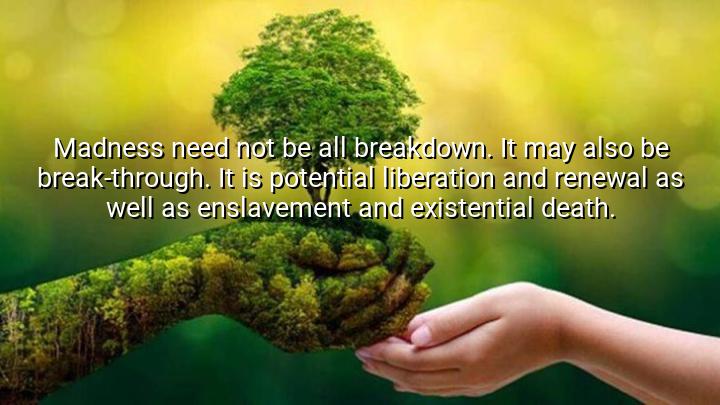




R. D. Laing’s quote challenges the conventional view of madness as merely a breakdown or a negative condition. Instead, he presents it as a potential break-through, suggesting that what is often perceived as mental disorder can also be a path to liberation and renewal. Laing implies that madness can represent a process of transformation, where the person undergoing this experience might break free from societal norms, uncover new perspectives, and find a sense of freedom. While he acknowledges the possibility of enslavement and death associated with madness, he also recognizes its potential to lead to personal growth and deeper self-understanding.
R. D. Laing was a Scottish psychiatrist and psychotherapist who became famous for his unconventional views on mental illness. He often focused on how social structures and personal relationships contribute to psychological distress. His work emphasized that traditional psychiatric diagnoses could sometimes overlook the personal context in which madness arises, leading to a more holistic understanding of mental health. In this quote, Laing reflects his belief that psychosis or mental illness should not always be seen as something purely destructive but as an opportunity for personal liberation and insight.
The phrase “potential liberation and renewal” suggests that the experience of madness can be transformative, leading to self-discovery and a shedding of previous limitations. Laing proposes that those who experience madness may find themselves freed from the constraints of societal expectations and mental habits, allowing for a new way of thinking and being. On the other hand, Laing is also aware of the dark side of madness, where it can lead to alienation, enslavement, and existential death, particularly when it is misunderstood or untreated.
The origin of this quote lies in Laing’s influential work, particularly in his writings such as The Politics of Experience and The Divided Self. Laing’s views on mental health and psychosis were radical for his time, as he emphasized the experiential and contextual aspects of mental illness. This quote encapsulates Laing's belief in the dual nature of madness, offering both the potential for profound personal change and the risk of deep alienation from society.

AAdministratorAdministrator
Welcome, honored guests. Please leave a comment, we will respond soon