

The discrimination of women and girls goes to the core of any and all analyses of the world's economic, political, and environmental problems.
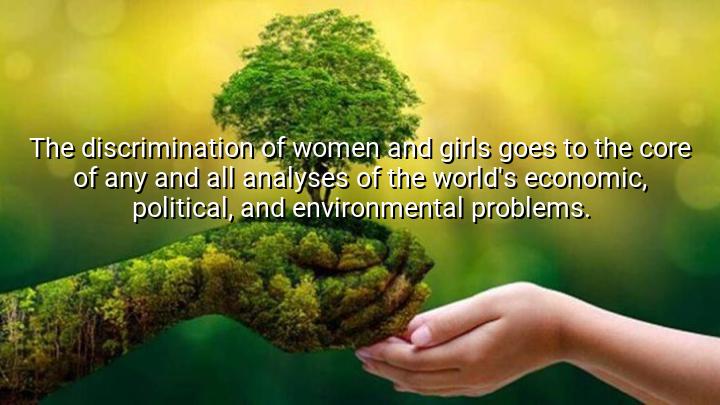




The quote by Winnie Byanyima emphasizes the fundamental role of gender equality in understanding and addressing global challenges. By asserting that the discrimination of women and girls lies at the heart of economic, political, and environmental issues, she highlights how systemic inequities affect not only individuals but entire societies. This perspective suggests that without confronting gender-based discrimination, solutions to global problems will be incomplete or ineffective.
Byanyima’s statement connects social justice directly to economic and political structures. For instance, limiting women’s access to education, leadership, or employment opportunities constrains economic growth and reduces societal resilience. Similarly, political systems that marginalize women fail to fully represent the needs of communities, resulting in policies that may perpetuate inequality and hinder progress. The quote underscores that empowering women is not just a moral imperative but a practical necessity for sustainable development.
The reference to environmental problems reflects growing recognition that women are disproportionately affected by issues such as climate change, resource scarcity, and environmental degradation. Studies have shown that empowering women in decision-making roles can lead to more effective and equitable environmental policies. Byanyima, as a prominent advocate for human rights and global development, draws on these insights to argue that gender discrimination is deeply intertwined with the world’s most pressing challenges.
Ultimately, the quote calls for a holistic approach to problem-solving. By addressing the discrimination of women and girls, societies can unlock the full potential of their populations, improve governance, foster economic growth, and create more sustainable solutions for the planet. Byanyima’s perspective positions gender equality not as a peripheral issue but as a central factor in achieving global progress.

AAdministratorAdministrator
Welcome, honored guests. Please leave a comment, we will respond soon