

The discovery and investigation of life on other planets is likely to change many of our ideas about how life arose on the Earth and even what is life and its natural development.
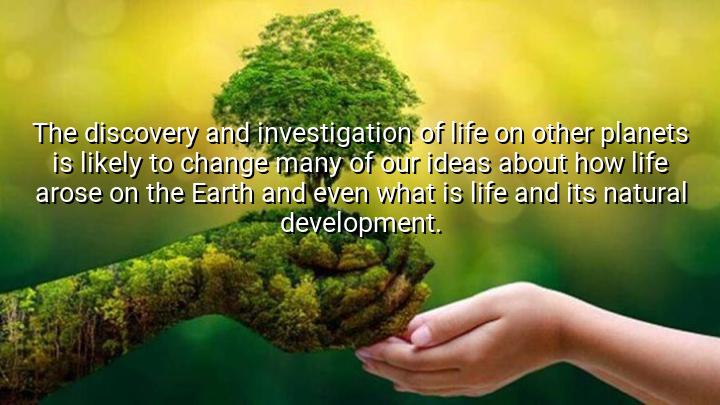




George Smoot’s quote, “The discovery and investigation of life on other planets is likely to change many of our ideas about how life arose on the Earth and even what is life and its natural development,” reflects a profound anticipation of how scientific discovery—especially in the realm of astrobiology—could reshape our fundamental understanding of life. He suggests that encountering extraterrestrial life, whether microbial or complex, would force us to reconsider long-held assumptions about life’s origins, evolution, and definition.
The phrase “change many of our ideas” indicates that current theories about how life arose on Earth are based on a singular, Earth-centric sample. Discovering life elsewhere would offer comparative insight, potentially showing that life can begin and evolve under vastly different conditions. This would not only broaden our view of biological possibilities, but also deepen our understanding of Earth’s own unique or shared pathways of development.
Smoot also raises the question of “what is life,” challenging scientists and philosophers alike to re-examine the criteria and boundaries we use to define living organisms. If extraterrestrial life is found to operate through unfamiliar biochemistry or behavior, it could dramatically shift our scientific framework and our philosophical outlook on existence, intelligence, and even consciousness.
The origin of this quote lies in George Smoot’s work as a cosmologist and Nobel Prize-winning physicist, known for his contributions to understanding the cosmic background radiation and the early universe. His statement reflects his broader interest in fundamental questions about existence and the universe’s potential for life beyond Earth. It highlights the transformative impact that such discoveries would have—not only on science, but on human perspective itself.

AAdministratorAdministrator
Welcome, honored guests. Please leave a comment, we will respond soon