

The death penalty confronts us with a penetrating moral question: Can even the monstrous crimes of those who are condemned to death and are truly guilty of such crimes erase their sacred dignity as human beings and their intrinsic right to life?
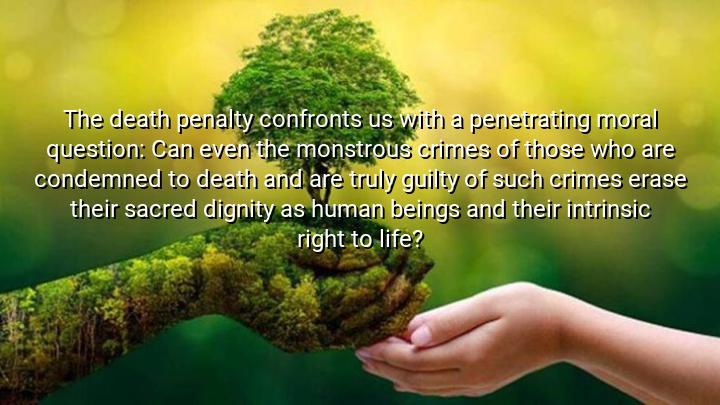




In this quote, Blase J. Cupich, a prominent Catholic Cardinal, raises a deep moral question about the ethics of the death penalty. He challenges the idea that even the most monstrous crimes committed by those found guilty should result in the complete loss of their human dignity and their intrinsic right to life. Cupich is questioning whether the severity of a crime can justify taking away the fundamental right to life that every human being holds, regardless of their actions.
Cupich’s quote touches on the philosophical and ethical debate surrounding the death penalty, particularly in the context of punishment and justice. He acknowledges the gravity of the crimes that might lead someone to be sentenced to death but insists that these crimes do not necessarily strip away a person’s inherent worth. This argument draws on the belief that human dignity is sacred and that no crime should diminish a person’s value as a human being.
The quote also highlights the tension between retribution and rehabilitation in justice systems. By suggesting that even those who are truly guilty of horrific crimes retain their right to life, Cupich is advocating for a justice system that focuses on redemption and the recognition of a person’s inherent dignity, rather than on retribution. His view is aligned with those who oppose the death penalty on the grounds that it is a violation of basic human rights.
Ultimately, Blase J. Cupich's quote serves as a challenge to the moral and religious justification of the death penalty, urging a reconsideration of whether punishment should be administered in a way that acknowledges the sacred dignity of all individuals, regardless of their crimes. It calls for reflection on the principles of justice and human rights, particularly in the context of capital punishment.

AAdministratorAdministrator
Welcome, honored guests. Please leave a comment, we will respond soon