

That last day does not bring extinction to us, but change of place.
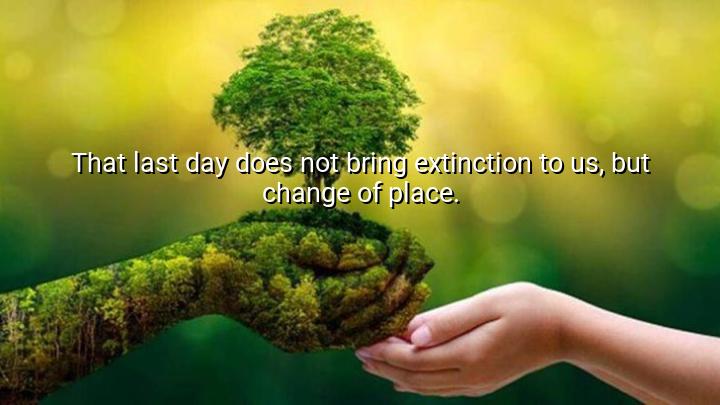




This quote by Marcus Tullius Cicero reflects a philosophical perspective on death and the afterlife, emphasizing the idea of transformation rather than finality. When Cicero says, “That last day does not bring extinction to us, but change of place,” he suggests that death should not be feared as the end of existence, but seen as a transition to another state or realm. This view aligns with many ancient philosophical and spiritual beliefs that regard life and death as part of a continuous cycle rather than a strict ending.
Cicero’s words offer comfort by framing death as a change of place, implying that the soul or essence of a person moves on to a different existence. This idea challenges the notion of total annihilation and encourages acceptance of death as a natural and inevitable process. It promotes a mindset focused on the continuity of the self, providing hope and reducing fear about the unknown.
The origin of this quote comes from Cicero’s writings, particularly his philosophical works on Stoicism and Platonism in the late Roman Republic. Cicero was a renowned orator, statesman, and philosopher, whose essays often explored themes of mortality, virtue, and the soul. His reflections on death reflect the broader Roman intellectual tradition that sought to reconcile human fears with rational and ethical understanding.
Ultimately, Cicero’s quote invites us to view death through the lens of change and continuity, rather than loss and finality. It encourages a thoughtful acceptance of mortality and inspires a belief in something beyond our current existence—a “change of place” that is part of the larger mystery of life and the universe.

AAdministratorAdministrator
Welcome, honored guests. Please leave a comment, we will respond soon