

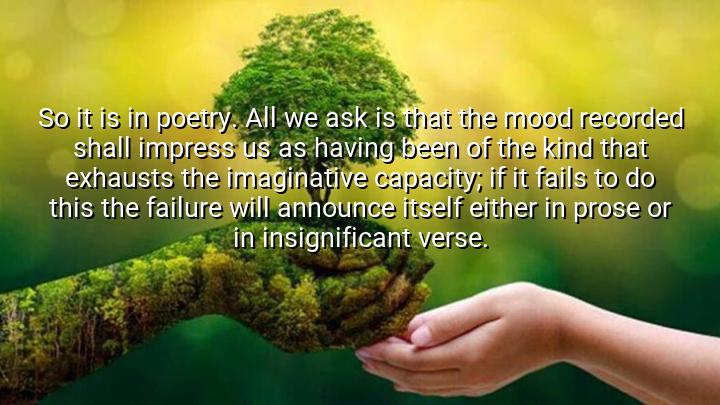
So it is in poetry. All we ask is that the mood recorded shall impress us as having been of the kind that exhausts the imaginative capacity; if it fails to do this the failure will announce itself either in prose or in insignificant verse.
So it is in poetry. All
So it is in poetry. All we ask is that the mood recorded shall impress us as having been of the kind that exhausts the imaginative capacity; if it fails to do this the failure will announce itself either in prose or in insignificant verse.

So it is in poetry. All
So it is in poetry. All we ask is that the mood recorded shall impress us as having been of the kind that exhausts the imaginative capacity; if it fails to do this the failure will announce itself either in prose or in insignificant verse.
So it is in poetry. All
So it is in poetry. All we ask is that the mood recorded shall impress us as having been of the kind that exhausts the imaginative capacity; if it fails to do this the failure will announce itself either in prose or in insignificant verse.
So it is in poetry. All
So it is in poetry. All we ask is that the mood recorded shall impress us as having been of the kind that exhausts the imaginative capacity; if it fails to do this the failure will announce itself either in prose or in insignificant verse.
So it is in poetry. All
So it is in poetry. All we ask is that the mood recorded shall impress us as having been of the kind that exhausts the imaginative capacity; if it fails to do this the failure will announce itself either in prose or in insignificant verse.
So it is in poetry. All

Certainly! Here’s an explanation with bolded keywords related to the quote:

John Drinkwater’s quote reflects on the essence and purpose of poetry. He suggests that the key requirement in poetry is that the mood it conveys must be so profound and intense that it exhausts the imaginative capacity of both the poet and the reader. If a poem fails to achieve this depth of emotional or imaginative engagement, it reveals itself as a failure, which might manifest as dull prose or insignificant verse.

The origin of this quote lies in Drinkwater’s work as a poet and playwright during the early 20th century, where he emphasized the power of poetry to evoke strong feelings and stimulate the imagination. His words capture the challenge poets face in creating work that moves beyond mere words to something truly impactful and immersive.

This quote highlights the difference between ordinary writing and great poetry, which should resonate deeply and expand the reader’s experience. It sets a high standard for poetic expression, suggesting that only work that fully engages the imagination can be considered successful poetry.

In essence, John Drinkwater’s statement underscores the demanding nature of poetry as an art form. It reminds us that poetry must not only communicate but also evoke a powerful mood that stretches the boundaries of imagination and emotion.

John Drinkwater
John Drinkwater

English - Poet June 1, 1882 - March 25, 1937

Have 0 Comment So it is in poetry. All

AAdministratorAdministrator

Welcome, honored guests. Please leave a comment, we will respond soon

Reply.
Information sender
Leave the question
Click here to rate
Information sender
0.14099 sec| 2548.211 kb