

Since the day of my birth, my death began its walk. It is walking toward me, without hurrying.
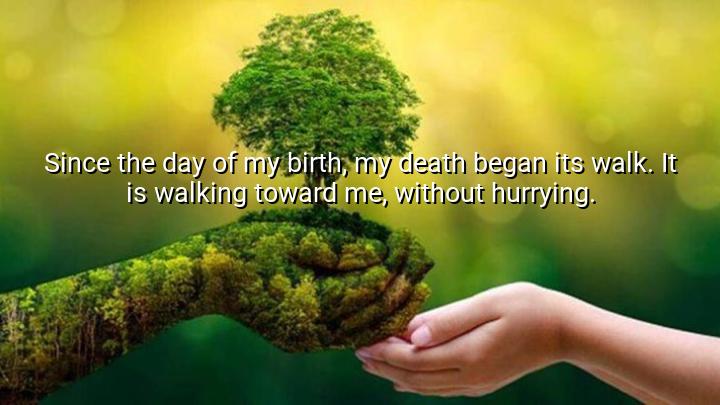




The quote "Since the day of my birth, my death began its walk. It is walking toward me, without hurrying" by Jean Cocteau reflects a philosophical meditation on the inevitable nature of death. Cocteau suggests that from the moment of birth, the process of dying begins—a slow, unavoidable journey that we cannot escape. The idea that death is "walking toward me, without hurrying" emphasizes that death is a constant presence in our lives, advancing steadily but gradually, without urgency or pause. It reminds us that mortality is not something distant or abstract but a fundamental part of our existence.
The origin of this quote lies in Cocteau's broader artistic vision, which often delved into the themes of life, death, and the passage of time. Cocteau, a French artist, filmmaker, and writer, frequently explored the human condition through a surrealist lens, focusing on the tension between existence and non-existence. His works often questioned the boundaries between life and death, and this quote encapsulates his existential view that death is a continual part of the human experience, even from the very beginning.
Cocteau's words also serve as a reminder of the inevitability and unpredictability of death. By framing death as a slow, constant force that begins with birth, he emphasizes the fragility and impermanence of life. The idea that death walks "without hurrying" suggests that it doesn't rush, and it can't be avoided, yet it doesn’t create panic—it’s simply a part of the natural rhythm of existence.
In essence, this quote encourages reflection on the passage of time and the certainty of death. Cocteau invites us to acknowledge that our mortality is not something to fear or resist but to accept as an intrinsic part of our journey. By recognizing death's quiet, inevitable march toward us, we might come to appreciate the present moment more fully, living with the awareness that time is always moving forward.

AAdministratorAdministrator
Welcome, honored guests. Please leave a comment, we will respond soon