

Scientists and philosophers tend to treat knowledge, imagination and love as if they were all very separate parts of human nature. But when it comes to children, all three are deeply entwined. Children learn the truth by imagining all the ways the world could be, and testing those possibilities.
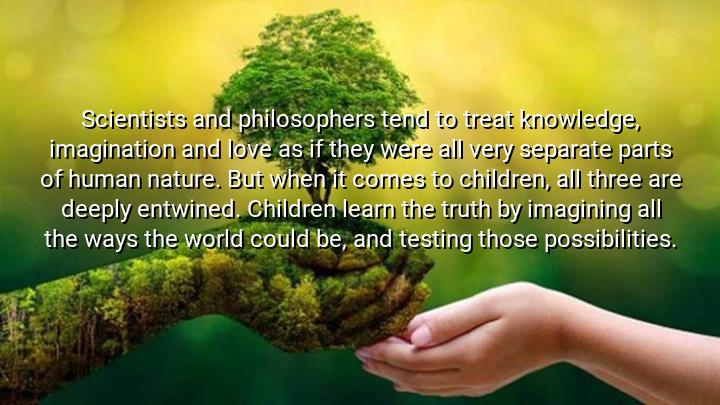




In this quote, Alison Gopnik reflects on how scientists, philosophers, and others often treat knowledge, imagination, and love as separate aspects of human nature. These fields, especially in traditional academic thought, tend to compartmentalize these elements. However, Gopnik argues that in the case of children, these three elements—knowledge, imagination, and love—are not separate but are deeply entwined. For children, learning and emotional connection occur simultaneously, and they do not compartmentalize their experience in the way that adults might.
Gopnik further explains that children use imagination as a vital tool for learning. They explore the world not just by acquiring facts but by imagining all the different possibilities of how the world could be. Through this imaginative play, children test out these possibilities, trying them out in real life to see which ones are true or work. This process of blending imagination with experience is how they begin to understand the world around them, constantly experimenting with new ideas and perspectives.
The quote also highlights the importance of imagination in the development of knowledge. For children, imagination is not just about fantasy but serves as a means to understand reality. They use imagination to form hypotheses, test them, and gain insights into how the world works. Gopnik suggests that imagination is a dynamic and essential part of the learning process, especially in children, who often learn best when they have the freedom to explore and experiment with their ideas.
Ultimately, Gopnik’s quote challenges the traditional separation between different aspects of human nature, such as knowledge, imagination, and love. For children, these are not distinct and isolated, but interconnected, with each one supporting the development of the others. She emphasizes that by allowing children to imagine and test possibilities, we help them develop a deeper and more integrated understanding of the world around them.

AAdministratorAdministrator
Welcome, honored guests. Please leave a comment, we will respond soon