

Right now, computers, which are supposed to be our servant, are oppressing us.
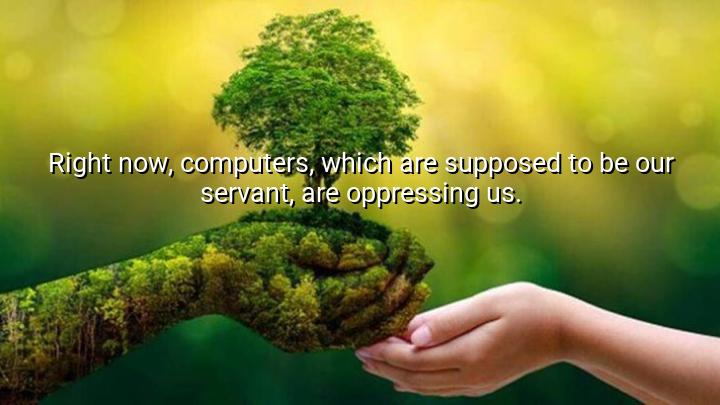




In this quote, Jef Raskin, a pioneering computer scientist and human-computer interaction expert, expresses his frustration with the way computers have evolved from being tools designed to serve humans to systems that, in some cases, dominate our lives. Raskin suggests that instead of serving their intended purpose, computers are now becoming oppressive, with the demands of technology and constant innovation often leading to frustration and a loss of control for users. His words reflect concerns about the ways in which computers and digital systems have become central to nearly every aspect of life, sometimes to the point of creating dependency and limiting human autonomy.
Raskin's statement highlights the paradox of technology: while it was meant to empower and assist us, it has, for many, become a source of stress, overload, and complexity. The very tools designed to make tasks easier and more efficient can often cause more problems than they solve, as they can be difficult to use, prone to malfunction, or create expectations for productivity that lead to burnout. Raskin's critique speaks to a growing sense that the role of computers has shifted from empowering individuals to controlling and dictating how we spend our time and energy.
The origin of this quote can be traced to Raskin's work in human-computer interaction, where he was a key figure in the development of early graphical user interfaces. As the designer behind Apple's Macintosh project, Raskin had a vision for computers that were intuitive and user-friendly, making them tools that served human needs rather than creating barriers to productivity or well-being. His frustrations likely stem from his experiences witnessing how technology, particularly computers, evolved in ways that didn't always prioritize user experience and simplicity.
Ultimately, Raskin’s quote is a call to rethink our relationship with technology. He suggests that as computers become more complex and integrated into daily life, they should remain tools that empower and assist us, rather than forces that control or overwhelm us. The statement serves as a reminder that while technology has great potential, its impact is shaped by how it is designed, used, and integrated into our lives.

AAdministratorAdministrator
Welcome, honored guests. Please leave a comment, we will respond soon