

Rewards and punishments are the lowest form of education.
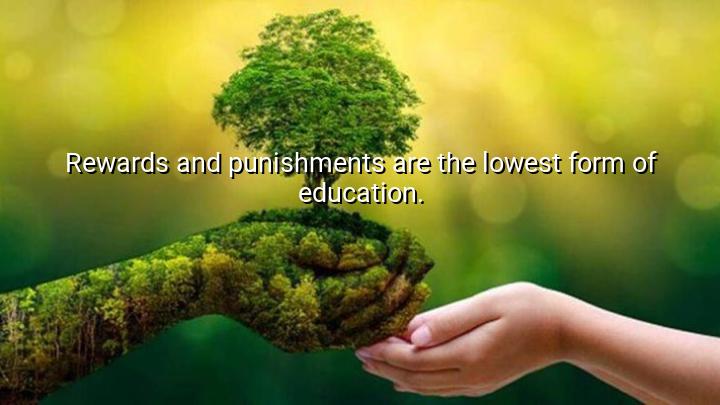




In the quote "Rewards and punishments are the lowest form of education," Zhuangzi, an influential Daoist philosopher, critiques the reliance on external motivation in the learning process. He suggests that the use of rewards (positive reinforcement) and punishments (negative reinforcement) is an ineffective way to teach, as it primarily addresses surface behavior rather than nurturing deep understanding and internal growth. According to Zhuangzi, true education should not be based on external rewards or consequences but on the development of inner wisdom, self-discipline, and a genuine love for learning.
Zhuangzi's philosophy, rooted in Daoism, emphasizes the importance of naturalness and spontaneity in personal growth. He believed that learning should be a process of aligning with the Dao (the natural way of the universe), rather than being shaped by external, rigid incentives. The use of rewards and punishments, in Zhuangzi’s view, can lead to a form of behavioral conditioning that limits true creativity and self-motivation. Instead, education should cultivate intrinsic curiosity and the desire to learn for the sake of learning, not merely to avoid punishment or gain reward.
The idea of rewards and punishments as the "lowest form of education" also speaks to Zhuangzi’s belief that wisdom cannot be imposed from the outside. The goal of education should be to guide individuals to self-realization and self-cultivation, allowing them to find their own path and purpose. By focusing on intrinsic motivation rather than external rewards, education becomes a means of personal transformation rather than mere compliance.
Ultimately, Zhuangzi’s quote challenges conventional educational practices that emphasize extrinsic motivation and control. It calls for a deeper, more holistic approach to learning—one that nurtures the mind and spirit in a way that is not dependent on external validation. By focusing on internal growth and understanding, education becomes a more meaningful and lasting process.

AAdministratorAdministrator
Welcome, honored guests. Please leave a comment, we will respond soon