

I do not know whether I was then a man dreaming I was a butterfly, or whether I am now a butterfly dreaming I am a man.
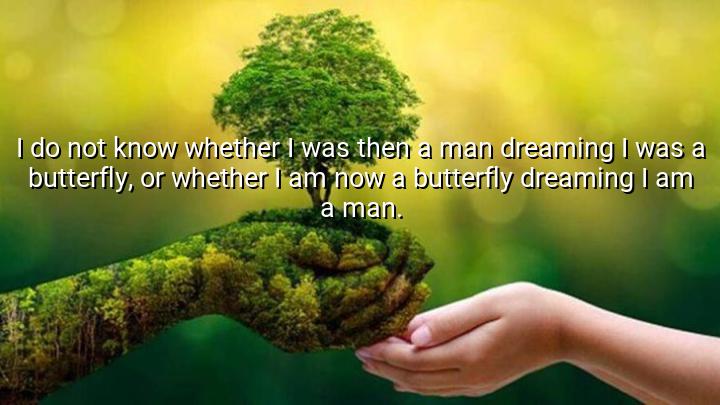




The quote "I do not know whether I was then a man dreaming I was a butterfly, or whether I am now a butterfly dreaming I am a man" by Zhuangzi reflects the philosophical uncertainty about the nature of reality and identity. Zhuangzi, a foundational figure in Daoism, uses this paradoxical statement to explore the fluidity between the self and the world, suggesting that the boundaries between who we are and what we experience may not be as clear-cut as we think. This dreaming metaphor challenges the idea of fixed identity, indicating that our perceptions of self may be as transient and uncertain as a dream.
The quote speaks to the nature of perception and the idea that reality is subjective. Zhuangzi questions whether our experiences and understanding of the world are simply constructs, much like a dream, where the boundaries of the self dissolve. This idea touches on philosophical concepts of illusion and the interplay between consciousness and existence, which Zhuangzi often explored in his writings. In this context, the distinction between dream and reality becomes blurred, suggesting that what we experience in life may be no more substantial than a dream.
The origin of this quote comes from Zhuangzi’s famous work, the Zhuangzi, which is a collection of stories and philosophical musings that reflect Daoist thought. Zhuangzi often questioned conventional views of the world and emphasized the importance of accepting the uncertainty and impermanence of life. His teachings encouraged a deeper connection to the natural flow of life, suggesting that rigid distinctions between things, such as reality and dream, are ultimately illusory.
Ultimately, Zhuangzi’s quote encourages us to embrace uncertainty and challenge our fixed ideas of self and reality. It suggests that identity and experience are fluid and may not be as concrete as we often believe. By questioning the nature of our perceptions, Zhuangzi invites us to see life with greater openness, understanding that much of what we consider real may be shaped by our own awareness and the ever-changing nature of existence.

AAdministratorAdministrator
Welcome, honored guests. Please leave a comment, we will respond soon