

Religion is the organization of spirituality into something that became the hand maiden of conquerors. Nearly all religions were brought to people and imposed on people by conquerors, and used as the framework to control their minds.
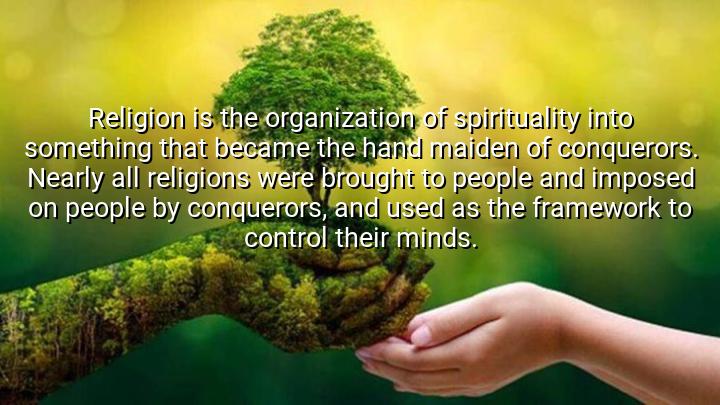




John Henrik Clarke’s quote, "Religion is the organization of spirituality into something that became the handmaiden of conquerors," critiques the way religion has often been used as a tool for power and control. Clarke suggests that spirituality, which is meant to be a personal, internal experience, has been institutionalized and manipulated by those in positions of authority. Instead of fostering genuine spiritual growth, religion has sometimes been shaped into a system that benefits rulers and conquerors, serving their interests rather than the people’s.
The phrase "handmaiden of conquerors" is particularly significant, as it implies that religion was not just a passive tool, but an active ally in the spread of empire and colonialism. Clarke argues that most religions were not simply shared with people for their spiritual benefit, but were imposed on conquered populations by colonial powers. This historical reality, he points out, often involved the use of religion as a framework to justify the domination and subjugation of indigenous peoples, shaping their beliefs and behaviors in ways that aligned with the conquerors' objectives.
Clarke's statement also addresses the idea that religion was used as a means to control the minds of people. By instituting a particular religious belief system, conquerors were able to manipulate not only the actions of the people but also their thoughts and values. Religion became a vehicle for enforcing conformity, obedience, and loyalty to the ruling powers. This created a cultural environment where religious doctrine was inextricably linked to political authority, reinforcing the social hierarchies that maintained the conquerors’ control.
In the broader context of history and social justice, Clarke’s quote challenges us to critically examine how religion has been historically weaponized by powers seeking to dominate others. It calls for a deeper understanding of how spiritual practices, when institutionalized, can be used as instruments of oppression rather than liberation. Clarke’s view encourages us to think more consciously about how faith and power intersect and the ways in which spirituality should return to its roots of personal enlightenment and freedom.

AAdministratorAdministrator
Welcome, honored guests. Please leave a comment, we will respond soon