

Our obligation to fight pollution traces the roots of its persuasion to that same moral mountaintop from which my father lent his voice to the voiceless. The pursuit of civil equality in health helped build our environmental laws.
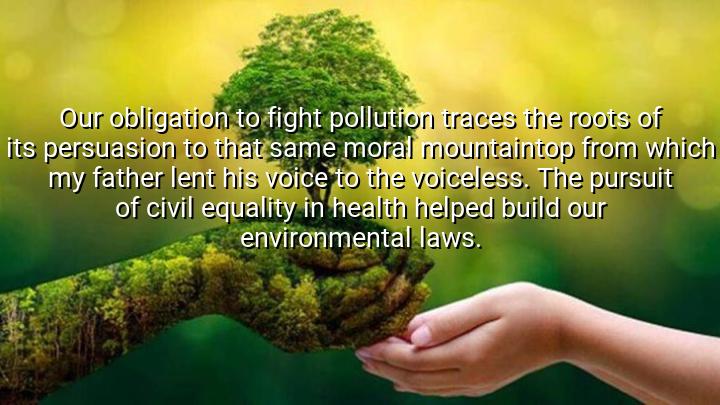




In this quote, Martin Luther King III draws a parallel between the fight for pollution control and his father’s legacy in advocating for civil equality. He suggests that the moral imperative to combat environmental harm is rooted in the same ethical foundation that his father, Dr. Martin Luther King Jr., used to champion the rights of the oppressed and voiceless. King III connects the pursuit of civil equality in health with the creation of environmental laws, arguing that the struggle for health equity and the protection of the environment are deeply intertwined.
King III’s statement implies that the fight against pollution is not just about preserving the physical environment, but also about ensuring that all individuals, especially marginalized communities, have access to a healthy environment. This connection emphasizes that environmental justice is a natural extension of the civil rights movement, which sought to ensure equal treatment for all people, particularly in terms of health and access to resources. He points out that environmental laws are not separate from social justice but are an integral part of the broader fight for equality.
The origin of this quote is rooted in Martin Luther King III's lifelong advocacy for social justice and human rights, following in the footsteps of his father. As a prominent figure in both the civil rights and environmental movements, King III has worked to highlight the importance of environmental justice, where the health of the planet and the well-being of individuals—particularly those in underserved communities—are prioritized. His perspective on environmental issues reflects his deep understanding of how social issues intersect with environmental policies.
Ultimately, King III’s quote reinforces the idea that the struggle for civil equality, particularly in the realm of health, has been foundational to the development of modern environmental laws. By tying the two movements together, he underscores the moral obligation to address pollution and environmental injustice, emphasizing that the fight for a better world involves both social and environmental reforms.

AAdministratorAdministrator
Welcome, honored guests. Please leave a comment, we will respond soon