

I'm proud of my father, but my pride cannot be fully measured by that snapshot in history. Because contrary to first glance, my father's legacy comes not from his presiding over the final act in the drama of fighting for equal rights - his legacy is about setting the stage.
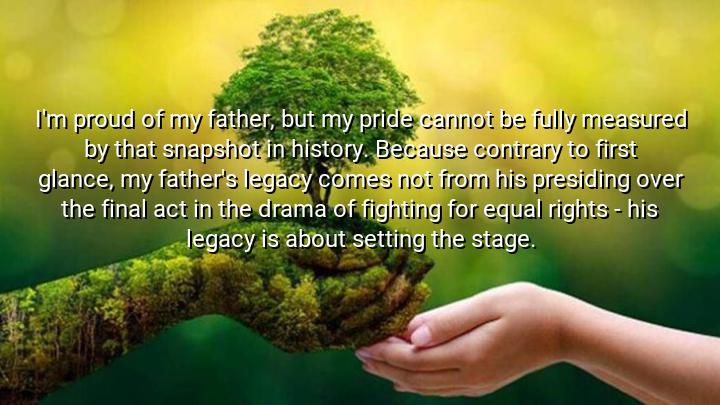




In this quote, Martin Luther King III reflects on his deep pride in his father, Dr. Martin Luther King Jr., while also acknowledging that his father’s true legacy extends beyond the iconic moments that are most often celebrated in history. King III emphasizes that while his father’s role in the civil rights movement, particularly in fighting for equal rights, is widely recognized, it is not the final act of the movement that defines his father’s impact. Instead, King Jr.'s legacy lies in his pioneering work in setting the stage for future change, creating a foundation for the ongoing struggle for justice.
King III's statement challenges the simplistic view of history, where individuals are often reduced to a single, iconic moment of achievement. Instead, he underscores that true leadership and change often begin long before the public’s attention turns to the final resolution of a conflict. By describing his father's legacy as about setting the stage, he acknowledges the long-term efforts, sacrifices, and groundwork that were necessary to make the later victories in civil rights possible. This view speaks to the importance of foundational work in any social movement.
The origin of this quote is grounded in Martin Luther King III’s perspective as the son of one of the most important figures in American history. His reflection on his father’s life and work highlights the often-overlooked aspects of social movements, where the initial struggles and the work of preparing the ground for change are just as crucial as the publicized victories. As someone who continues to be active in social justice, King III is well aware of the complexities of leadership and legacy.
Ultimately, King III’s quote serves as a reminder that history is shaped by more than just the dramatic moments that are often celebrated. The true impact of a leader’s work can be found in the foundational efforts that pave the way for lasting change. His father’s legacy, as he sees it, is about the slow and steady work of building momentum for civil rights, which laid the groundwork for future generations to continue the fight for equality and justice.

AAdministratorAdministrator
Welcome, honored guests. Please leave a comment, we will respond soon