

Our knowledge is a little island in a great ocean of nonknowledge.
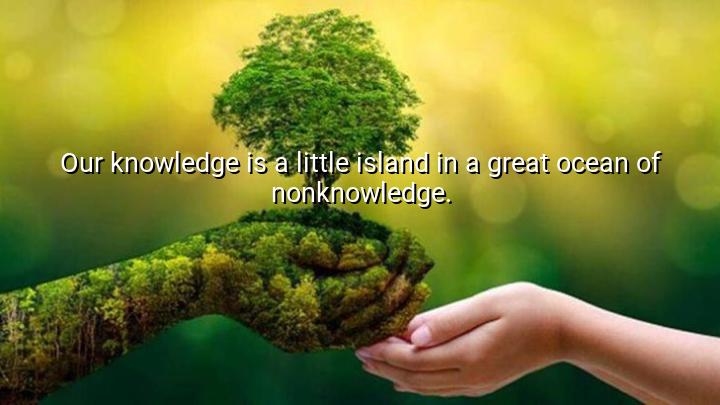




The quote "Our knowledge is a little island in a great ocean of nonknowledge." by Isaac Bashevis Singer highlights the vast limitations of human knowledge in comparison to the infinite mysteries of the universe. Singer uses the metaphor of an island to represent what humanity has discovered and understood, while the ocean symbolizes the immeasurable expanse of what remains unknown. This imagery emphasizes humility, reminding us that no matter how much we learn, there will always be far more that escapes our grasp.
The meaning of the quote suggests that while human beings have made great strides in science, philosophy, and art, our understanding is still small compared to the infinite complexities of existence. The idea of nonknowledge points to the areas where we have no answers—questions about life, the universe, consciousness, and even the future. By framing knowledge as limited and fragile, Singer encourages curiosity, wonder, and continuous exploration, rather than complacency.
The origin of this thought can be traced to Singer’s philosophical outlook and literary style. As a Nobel Prize-winning writer, Singer often reflected on the mysteries of human life, fate, and spirituality in his stories. Influenced by Jewish mysticism and existential thought, he saw human wisdom as precious yet incomplete, always surrounded by uncertainty. This perspective aligns with both religious humility before the unknown and scientific acknowledgment of the vastness yet to be discovered.
Ultimately, Singer’s words remind us that knowledge should inspire not arrogance but awe. The island we stand on is important, but the ocean of nonknowledge is what gives meaning to our quest for discovery. It is this balance between what we know and what we cannot yet know that fuels the eternal human pursuit of truth.

AAdministratorAdministrator
Welcome, honored guests. Please leave a comment, we will respond soon