

Ordinary people seem not to realize that those who really apply themselves in the right way to philosophy are directly and of their own accord preparing themselves for dying and death.
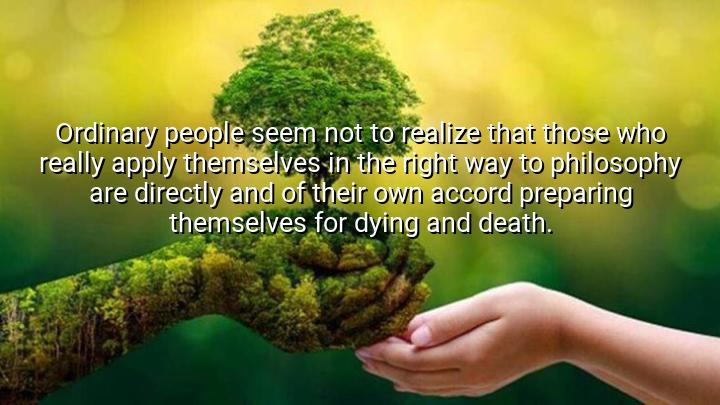




In this quote, Socrates suggests that philosophy has a deeper purpose than intellectual pursuit or knowledge alone. He argues that those who seriously engage in philosophical thought are, often unknowingly, preparing themselves for dying and death. For Socrates, philosophy is not just about abstract ideas; it is a way of confronting the inevitability of death and gaining clarity and understanding about the nature of existence. By examining life deeply, individuals begin to understand their own mortality, and in doing so, they prepare themselves for the transition from life to death.
The idea that philosophy leads one to acceptance of death is central to Socrates' view of life and its purpose. By focusing on virtue, wisdom, and the soul, philosophy encourages individuals to transcend the fear and uncertainty that often accompany the thought of death. Instead of avoiding or fearing it, a philosopher recognizes death as part of the natural order and develops the inner peace required to face it. For Socrates, true wisdom comes from understanding the impermanence of life and preparing for the inevitable with grace.
Socrates also emphasizes that ordinary people often fail to see this connection between philosophy and death. While many may view philosophical pursuits as abstract or irrelevant to daily life, he believed that the act of seeking truth and understanding in a disciplined way brings individuals closer to a more meaningful understanding of life and death. The practice of philosophy, for Socrates, is not just about academic knowledge, but about preparing one’s spirit and mind for the ultimate reality of human existence—death.
Originating from Socrates, the classical Greek philosopher who is considered one of the founders of Western philosophy, this quote reflects his belief in the purpose of philosophical inquiry. Socrates devoted much of his life to questioning assumptions, exploring moral virtues, and encouraging others to examine their lives, often in the context of death. His teachings, particularly as recorded by his student Plato, emphasize the pursuit of wisdom as a preparation for life’s greatest certainty: death.

AAdministratorAdministrator
Welcome, honored guests. Please leave a comment, we will respond soon