

Not life, but good life, is to be chiefly valued.
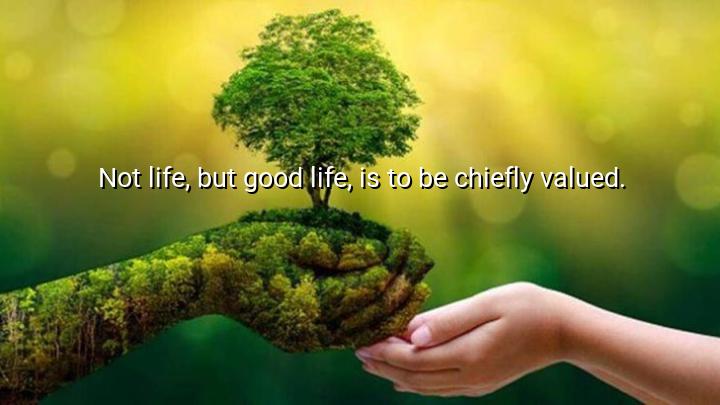




In this quote, Socrates emphasizes the importance of a good life over mere existence. He is not merely concerned with the fact that we are alive, but with how we live our lives—what we value, how we make choices, and the moral and ethical principles we follow. Socrates suggests that a life without reflection, virtue, or purpose is not worth as much as a life guided by wisdom, justice, and goodness. The focus is on living with intent, striving for moral excellence, and pursuing a life of virtue, rather than simply existing day to day without a deeper sense of purpose.
This quote encapsulates Socratic thought, which often revolves around the idea that living a meaningful, virtuous life is the true measure of success, rather than material wealth, social status, or even longevity. For Socrates, the quality of life—how one lives, the decisions one makes, and the impact one has—is far more important than just the fact of being alive. It’s a call for people to engage in self-examination and to live according to principles that lead to a life of fulfillment and moral integrity.
The origin of this quote lies in Socrates’ teachings, which have been preserved mainly through the writings of his student, Plato. Socrates believed in the pursuit of virtue through reason, encouraging individuals to question societal norms and personal assumptions in order to achieve a deeper understanding of themselves and the world around them. His philosophy centered on the idea that the examination of one’s life is crucial to its quality, famously stating, "The unexamined life is not worth living." This quote reinforces that notion, highlighting that it is the pursuit of the good life, rooted in reflection and virtue, that gives life its true value.
Ultimately, Socrates' quote invites us to focus not just on living, but on living well. It encourages an approach to life where the moral and ethical dimensions take precedence, reminding us that the worth of our existence lies in the choices we make and how we align our lives with the ideals of wisdom, justice, and virtue. The good life, in this sense, becomes a life marked by continual growth, reflection, and the pursuit of meaning.

AAdministratorAdministrator
Welcome, honored guests. Please leave a comment, we will respond soon