

One is still what one is going to cease to be and already what one is going to become. One lives one's death, one dies one's life.
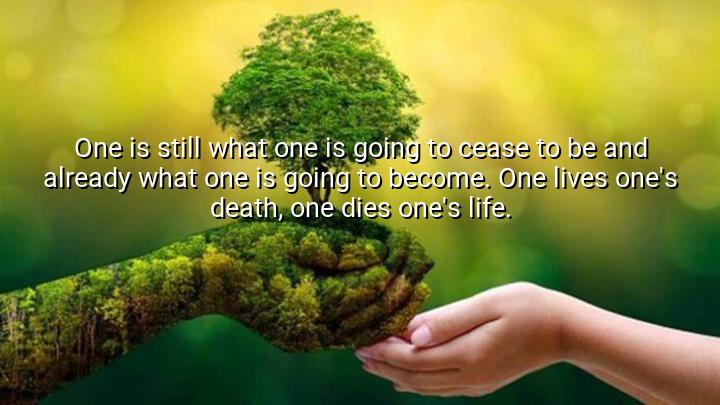




The quote "One is still what one is going to cease to be and already what one is going to become. One lives one's death, one dies one's life" by Jean-Paul Sartre reflects his existential philosophy on the nature of existence, time, and identity. Sartre, a leading figure in existentialism, suggests that life and death are not distinct and separate events but are intertwined throughout our existence. He proposes that we are constantly in a state of transition between what we are and what we are becoming, with death and life being part of this continuous process.
By saying "One is still what one is going to cease to be and already what one is going to become," Sartre emphasizes the fluidity of identity. Our present selves are always shaped by the awareness of both our past and the future. In this view, we are never static but always in the process of becoming, even as we move closer to our inevitable death. This perspective challenges the traditional view of life as a linear progression from birth to death, instead seeing it as a dynamic journey where the future influences the present just as much as the past does.
Sartre's assertion that "One lives one's death, one dies one's life" deepens this connection between life and death. He implies that death is not something that happens at the end of life, but is something that we carry with us throughout our existence. By being aware of our mortality, we are constantly living with the knowledge of our inevitable end, which shapes the way we experience and understand life. Similarly, we die bit by bit throughout our lives as we move closer to the point where our physical death will arrive.
Ultimately, Sartre’s quote speaks to the idea that life and death are existentially linked, and that our awareness of death shapes how we live and experience our existence. It suggests that we are never fully alive without the awareness of our mortality, and we are always moving toward an end that is already part of our present self. In this way, Sartre challenges us to confront the reality of both life and death as intertwined and fundamental to our understanding of existence.

AAdministratorAdministrator
Welcome, honored guests. Please leave a comment, we will respond soon