

Everything has been figured out, except how to live.
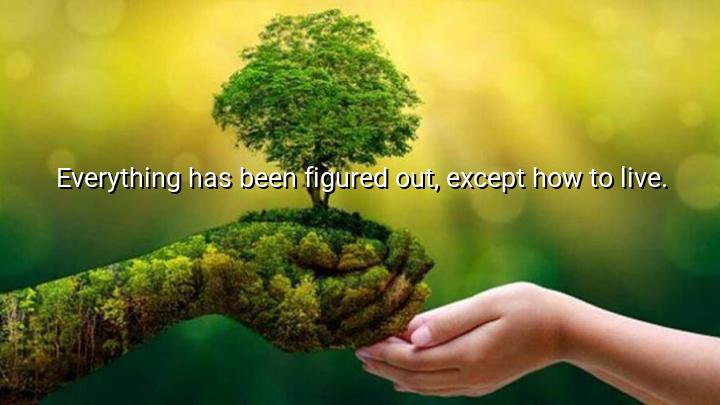




In this quote, Jean-Paul Sartre underscores the existential nature of human life, highlighting that while we may have made incredible strides in understanding the world, the most fundamental question—how to live—remains elusive. Sartre, a key figure in existentialism, emphasizes the paradox that, despite all our knowledge of science, society, and the cosmos, we still struggle to grasp the meaning of individual existence and how best to live authentically and purposefully. This reflects the existential belief that life does not come with predefined answers or instructions and that meaning is something we must create for ourselves.
Sartre's words point to the freedom and responsibility that come with being human. According to existential philosophy, we are not born with an inherent purpose or blueprint for how to live our lives. Instead, we are faced with the overwhelming task of defining ourselves, making choices, and embracing the uncertainty of our existence. This creates a tension between the rationality of human achievement in other areas (such as science and technology) and the irrationality of human existence, which lacks any guaranteed or clear path.
The origin of this quote lies in Sartre's philosophical works, particularly his focus on the absurdity and freedom inherent in the human condition. Sartre’s existentialist writings, such as Being and Nothingness, argue that life is not about discovering a universal or objective meaning, but about creating meaning through choices, actions, and authenticity. In this context, "how to live" is not a question with an external answer, but a deeply personal one that each individual must grapple with.
Ultimately, Sartre's quote calls attention to the existential dilemma we all face: how to live a life that feels meaningful and true in a world that offers no clear blueprint. It acknowledges the tension between human achievement in rational and practical domains and the deep, often unsettling mystery of human existence. In confronting this paradox, Sartre encourages us to embrace the freedom of defining our own lives, despite the discomfort and uncertainty that comes with it.

AAdministratorAdministrator
Welcome, honored guests. Please leave a comment, we will respond soon