

Observe constantly that all things take place by change, and accustom thyself to consider that the nature of the Universe loves nothing so much as to change the things which are, and to make new things like them.
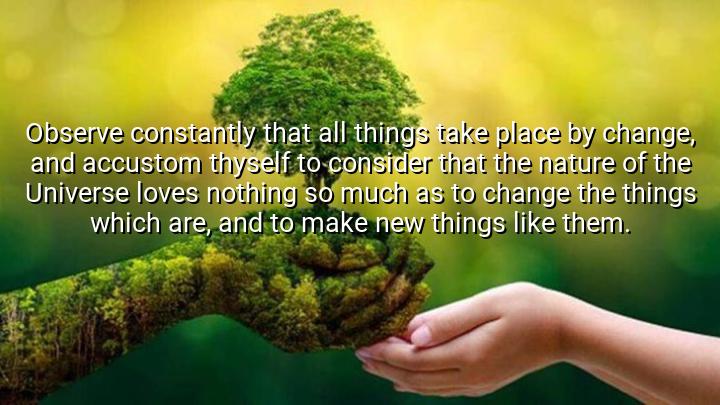




The quote "Observe constantly that all things take place by change, and accustom thyself to consider that the nature of the Universe loves nothing so much as to change the things which are, and to make new things like them." by Marcus Aurelius reflects a core principle of Stoic philosophy: the acceptance of impermanence and the inevitability of change. Marcus encourages us to observe the world and recognize that transformation is not only natural but essential to the order of the universe. Everything that exists is in a constant state of flux, and understanding this helps us live with greater wisdom and peace.
Marcus Aurelius, a Roman emperor and renowned Stoic thinker, wrote this passage in his philosophical journal, later compiled into the book Meditations. Written as a series of personal reflections during the 2nd century AD, Meditations offers guidance on how to live virtuously amid life's difficulties. This quote in particular urges the reader to embrace change not with fear or resistance, but with an understanding that it is the natural rhythm of existence.
The idea that the universe “loves” to change things speaks to the Stoic belief in a divine order or logos—a rational structure that governs the cosmos. From this viewpoint, change is not chaotic or random; rather, it is part of a larger, purposeful design. By accustoming ourselves to this truth, we reduce our anxiety about loss, uncertainty, or the future, and learn to align ourselves with the flow of life rather than oppose it.
Ultimately, Marcus Aurelius teaches us that by regularly reflecting on the nature of impermanence, we develop a sense of resilience and detachment. When we understand that everything is in motion—our relationships, careers, emotions, and even our bodies—we gain the clarity to appreciate the present moment and face life's changes with calm acceptance.

AAdministratorAdministrator
Welcome, honored guests. Please leave a comment, we will respond soon