

Not only does God play dice, but... he sometimes throws them where they cannot be seen.
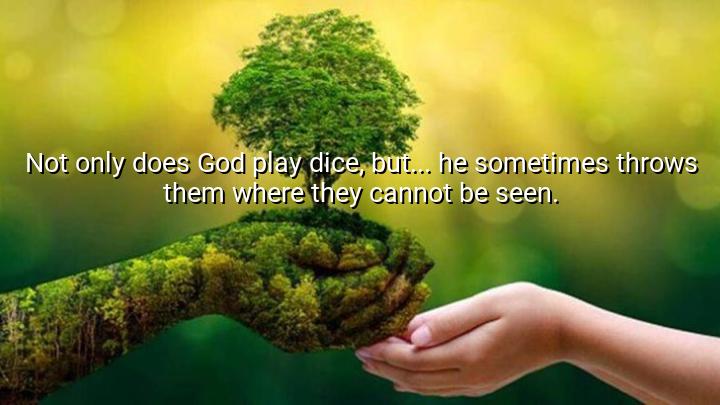




The quote "Not only does God play dice, but... he sometimes throws them where they cannot be seen" by Stephen Hawking reflects the famous concept of uncertainty in quantum mechanics. Hawking, a world-renowned theoretical physicist, is alluding to Albert Einstein's well-known phrase that "God does not play dice," which rejected the idea of randomness in the universe. By contrast, Hawking embraces the idea that chance and uncertainty are integral parts of the universe and that the workings of God, or the fundamental forces of nature, might be driven by events that are not always predictable or observable. The "dice" metaphor suggests that the universe is not entirely deterministic and that randomness plays a key role in its structure.
The origin of this quote lies in Hawking's deep exploration of cosmology, quantum theory, and the nature of the universe. As a scientist, he revolutionized our understanding of black holes, gravity, and the origins of the universe, blending concepts of both science and philosophy. Hawking's comment on God and dice plays with the tension between faith and science, implying that the universe operates not strictly by divine design or prediction, but also through a degree of chaos and randomness that is beyond human comprehension.
The phrase "he sometimes throws them where they cannot be seen" suggests that there are aspects of existence that are beyond human observation and understanding. In quantum mechanics, particles and events often behave in ways that defy classical physics, where outcomes are uncertain and not directly observable. This part of the quote acknowledges that even if God (or the natural forces) may influence or set things into motion, the consequences of these influences may not always be apparent, and some aspects of reality remain hidden from our senses.
Ultimately, Hawking’s quote challenges traditional views of order and divinity by suggesting that the universe is not merely a predictable, divine machine but also one where uncertainty, randomness, and unseen forces shape its course. By merging the realms of science and philosophy, the quote reflects Hawking’s belief that both science and faith can coexist, but that the forces at play in the universe are more complex and mysterious than we can ever fully grasp.

AAdministratorAdministrator
Welcome, honored guests. Please leave a comment, we will respond soon