

Nonviolence is a powerful and just weapon. Indeed, it is a weapon unique in history, which cuts without wounding and ennobles the man who wields it.
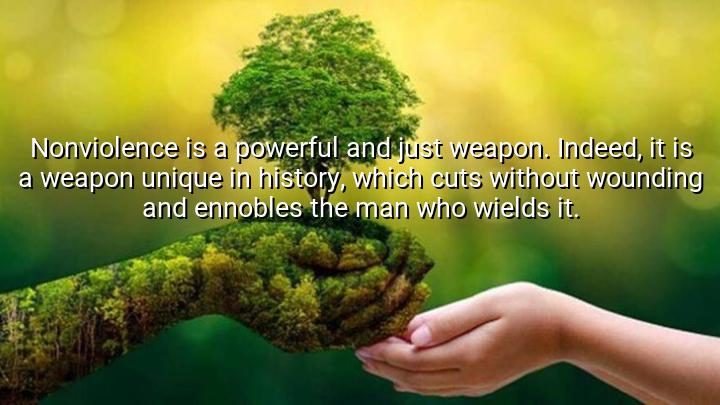




The quote by Martin Luther King, Jr. captures his philosophy of nonviolence as both a moral principle and a strategic tool for change. By calling it a “powerful and just weapon,” King reframes nonviolence not as passive resistance but as an active force capable of dismantling oppression. Its power lies in its ability to confront injustice without perpetuating cycles of violence, making it a method consistent with both ethics and effectiveness.
King describes nonviolence as “unique in history” because, unlike traditional weapons, it “cuts without wounding.” This metaphor suggests that nonviolence can expose injustice and strike at systems of oppression without harming individuals. Instead of degrading the one who uses it, nonviolence “ennobles the man who wields it,” elevating moral integrity and demonstrating the strength of character required to resist hatred with love and discipline.
This philosophy was central to King’s leadership during the Civil Rights Movement, where boycotts, marches, and peaceful protests were used to challenge racial segregation and discrimination. For King, nonviolence was not only about achieving civil rights but also about transforming society—breaking down barriers through moral force and showing the world a new path toward justice.
The origin of this quote comes from King’s speeches and writings in the 1960s, particularly his reflections on the role of nonviolent resistance in confronting systemic racism. Influenced by Mahatma Gandhi’s methods in India, King adapted the idea of nonviolence to the American context, making it a cornerstone of the movement. His words remain a reminder that true power lies not in destruction, but in the courage to fight injustice with peace, dignity, and moral clarity.

AAdministratorAdministrator
Welcome, honored guests. Please leave a comment, we will respond soon