

None of us, in our culture of comfort, know how to prepare ourselves for dying, but that's what we should do every day. Every single day, we die a thousand deaths.
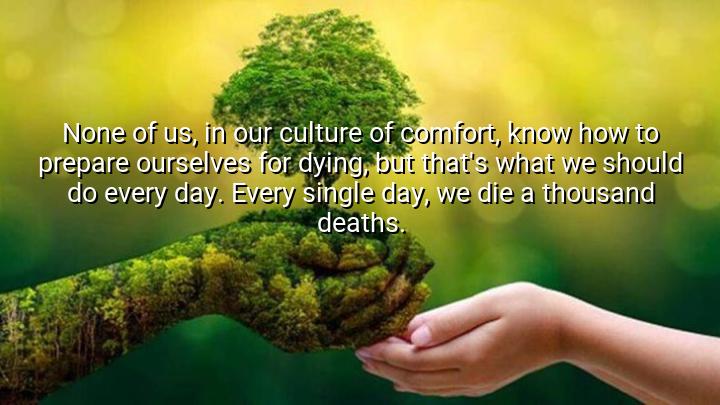




The quote "None of us, in our culture of comfort, know how to prepare ourselves for dying, but that's what we should do every day. Every single day, we die a thousand deaths" by Joni Eareckson Tada reflects on the concept of mortality and the human condition in a society that often avoids facing the reality of death. Tada suggests that, in a culture focused on comfort and preservation, we are unprepared for the inevitability of death. She proposes that we should confront the idea of dying on a daily basis, embracing it as a way to live more meaningfully and in alignment with our true purpose.
The origin of this quote comes from Tada’s own life and experiences. As a quadriplegic and Christian author, she has faced significant physical and emotional challenges. After a diving accident that left her paralyzed, Tada found herself confronting the reality of suffering, loss, and life’s fragility. Her journey has led her to reflect deeply on death, suffering, and the spiritual lessons that come with facing one’s mortality. This quote represents Tada's understanding that we must learn to face death and its implications in order to truly live.
Tada’s statement also highlights the inevitability of death, suggesting that each day is a form of dying—whether through the passing of time, personal struggles, or the emotional sacrifices we make. The idea of dying "a thousand deaths" emphasizes the cumulative and constant nature of loss in life. Every moment brings us closer to the end, and each challenge or letdown could be seen as a metaphorical death, helping us to grow and accept the transient nature of life.
In essence, this quote calls for a shift in how we view life and death. Tada urges us to prepare for our mortality not through fear or avoidance, but through acceptance and awareness. By acknowledging death as an ever-present part of life, we may learn to live more intentionally, appreciating the present moment and embracing the lessons that come with facing life’s impermanence.

AAdministratorAdministrator
Welcome, honored guests. Please leave a comment, we will respond soon