

No sooner does man discover intelligence than he tries to involve it in his own stupidity.
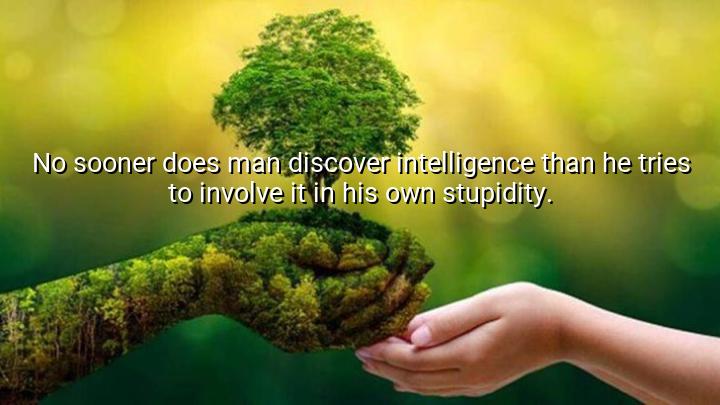




Jacques Yves Cousteau, a renowned explorer and conservationist, captures a profound irony in his quote: “No sooner does man discover intelligence than he tries to involve it in his own stupidity.” The statement suggests that humans, upon gaining the ability to think critically and understand complex concepts, often misuse their intelligence, leading to decisions that contradict their own better judgment. In essence, Cousteau is commenting on the paradox of human behavior—rational thinking is frequently overshadowed by irrational actions.
Cousteau’s words point to a tendency among humans to allow emotions, ego, or short-sightedness to influence their decisions, even when they possess the tools for logical thinking. This can be seen in various facets of life, such as politics, technology, and environmental practices, where people sometimes make choices that ultimately harm themselves or the planet, despite having the knowledge to do otherwise. His observation is a critique of human self-sabotage.
In this context, intelligence refers not only to cognitive ability but also to the wisdom that comes from learning and experience. Cousteau, an advocate for environmental awareness, may have been hinting at how humanity’s growing understanding of the natural world is often accompanied by actions that undermine that knowledge. For example, humans have the intelligence to recognize the importance of conservation, yet they continue to engage in behaviors that threaten the very ecosystems they understand.
Ultimately, Cousteau’s quote serves as a reminder that intelligence alone is not enough for progress. It must be paired with responsibility, humility, and a genuine commitment to applying knowledge in ways that benefit not only the individual but also society and the world as a whole.

AAdministratorAdministrator
Welcome, honored guests. Please leave a comment, we will respond soon