

No society has been able to abolish human sadness, no political system can deliver us from the pain of living, from our fear of death, our thirst for the absolute. It is the human condition that directs the social condition, not vice versa.
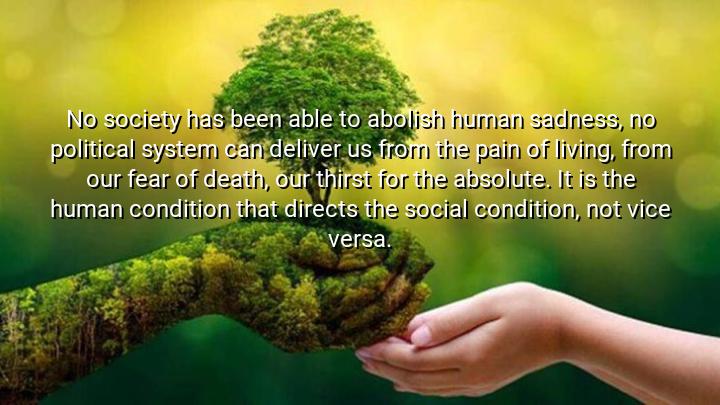




In this quote, Eugene Ionesco, a Romanian-French playwright known for his work in the Theatre of the Absurd, reflects on the inherent aspects of the human condition. He argues that no society or political system has the power to eliminate the fundamental sadness, pain, and existential fears that come with being human. Despite attempts at creating perfect social structures or systems of governance, these deep-rooted emotional and spiritual struggles—such as the fear of death and the longing for the absolute—remain untouched.
Ionesco’s words emphasize that human nature, with all its complexities and contradictions, cannot be easily controlled or resolved by external systems. He challenges the idea that political or social structures can fully address the existential dilemmas people face, suggesting that it is our inner struggles—not societal conditions—that ultimately shape our lives. In this sense, the social condition is influenced by the human condition, not the other way around. This reflects his belief in the limitations of external systems in resolving deeper, more personal issues.
The quote also alludes to the thirst for the absolute, which points to the human desire for meaning, truth, and a sense of transcendence. Ionesco seems to suggest that this yearning cannot be fully satisfied by material or political solutions, as it speaks to the spiritual and philosophical needs of individuals. This aligns with his broader existential themes, where human beings are often trapped in a world that fails to provide ultimate answers to life’s most profound questions.
Originating from Eugene Ionesco, a major figure in the Theatre of the Absurd, this quote reflects his exploration of absurdism and the existential dilemmas of human life. Ionesco’s works often depict characters grappling with the meaninglessness of existence, and this quote is a powerful statement on the limitations of societal solutions in addressing the existential fears that define the human experience. Through his plays and writings, he sought to illuminate the paradoxes of life and the struggles inherent in our search for meaning.

AAdministratorAdministrator
Welcome, honored guests. Please leave a comment, we will respond soon