

No evil can happen to a good man, either in life or after death. He and his are not neglected by the gods.
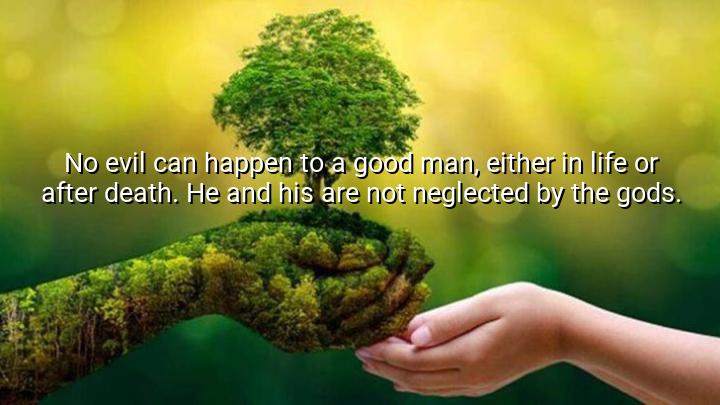




Socrates’s quote reflects his philosophical belief in the inherent protection and justice that surrounds a good man, regardless of the circumstances in life or even after death. He suggests that a virtuous person, by leading a morally sound life, will never face true evil, as they are under the care and protection of the gods. This speaks to the Greek notion of divine favor and moral order, where the gods reward those who live with virtue, integrity, and righteousness, ensuring that they are not abandoned, even in their death.
The quote also aligns with Socratic philosophy, which placed a strong emphasis on the importance of virtue and the idea that a morally good life leads to a form of protection or blessing. Socrates believed that a good person’s actions were in alignment with universal truths, and that moral conduct would always be rewarded, either during their life or in the afterlife. This reflects his faith in a higher moral order, where evil cannot truly harm a person who lives virtuously because their soul is beyond the reach of negative forces.
In this context, evil is not just physical harm but moral corruption or injustice, which Socrates argues cannot affect a good man because their actions and decisions are guided by wisdom and virtue. This belief offers a sense of comfort and security, reassuring that the truly good person is always in the care of a higher moral system, regardless of the challenges they may face. Even in death, which was often seen as an uncertain and final state, a good person is not forsaken.
The origin of this quote comes from Socrates’s teachings and his exploration of ethics and the nature of the soul. It is likely drawn from his thoughts on moral integrity and his belief in a just universe, as discussed in works like Plato’s "Apology" and other dialogues. Socrates’s enduring message in this quote is that the goodness of one’s soul and actions guarantees protection, and no external circumstance, not even death, can harm someone who lives a virtuous life.

AAdministratorAdministrator
Welcome, honored guests. Please leave a comment, we will respond soon