

My imagination is a monastery and I am its monk.
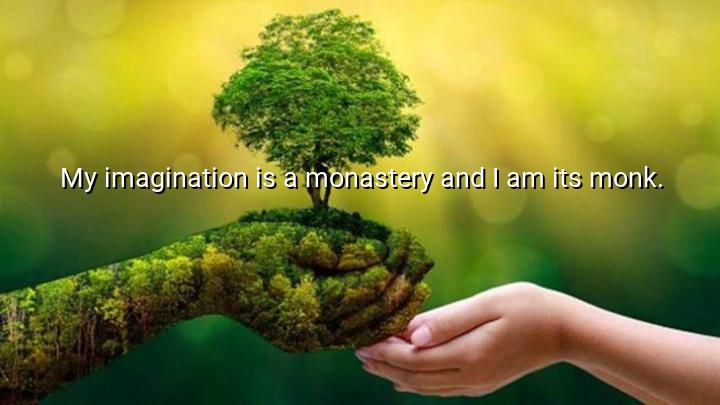




The quote "My imagination is a monastery and I am its monk" by John Keats speaks to the deeply personal and contemplative nature of the poet’s creative process. Keats, one of the leading figures of the Romantic movement, compares his imagination to a monastery, a place of solitude, reflection, and devotion. By identifying himself as a monk, he suggests that his relationship with his imagination is one of reverence, discipline, and spiritual dedication, similar to the way a monk would devote themselves to their faith in isolation and prayer.
Keats is conveying that his imagination is a sacred space where he is both the creator and the observer, reflecting on the world and channeling those thoughts into his poetry. Like a monk in a monastery, he is both secluded from the distractions of the world and deeply connected to his internal vision and spiritual self. His imagination is not just a tool for creativity but a refuge—a sacred realm where he can explore his deepest thoughts and emotions without external interruption.
The origin of this quote lies in Keats’ Romantic ideals, where imagination was seen as the bridge between the inner world of the artist and the outer world of nature and society. For Keats, imagination was the driving force behind his poetry, allowing him to transcend the limitations of ordinary life and explore profound human experiences. By referring to it as a monastery, Keats acknowledges the sanctity and purity of the creative process, emphasizing its importance in his life.
Ultimately, Keats’ quote highlights the profound role of imagination in the life of the artist, elevating it to a spiritual and personal practice. It suggests that the creative process is not just about producing work but involves a deep connection to one’s inner self and an ongoing commitment to nurturing that vision. Just as a monk finds peace and purpose in their solitude and devotion, Keats finds his purpose and peace within the sacred space of his imagination.

AAdministratorAdministrator
Welcome, honored guests. Please leave a comment, we will respond soon