

I have been astonished that men could die martyrs for religion - I have shuddered at it. I shudder no more - I could be martyred for my religion - Love is my religion - I could die for that.
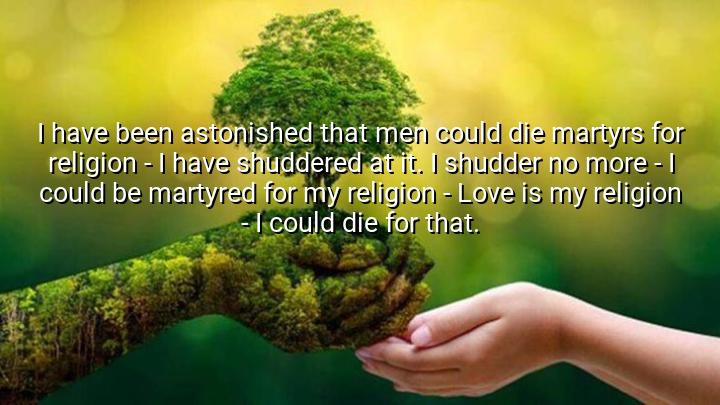




The quote by John Keats reflects a profound shift in his understanding of religion and devotion. Initially, he expresses astonishment and fear at the idea that men could die as martyrs for religious beliefs, highlighting the extreme commitment and often violent consequences associated with faith. However, Keats’ perspective evolves as he identifies love as his true religion, a principle for which he feels he could give his life, emphasizing the transformative power of emotion, passion, and human connection over traditional religious dogma.
The origin of this insight comes from Keats’ life as an English Romantic poet in the early 19th century, known for his reflections on beauty, love, and the human experience. His poetry often explored the depth of emotion, the fleeting nature of life, and the pursuit of meaning beyond societal or institutional structures. By equating love with religion, Keats elevates personal devotion and ethical commitment above formal doctrines.
At its core, the quote conveys that the essence of true faith may not lie in organized religion, but in the depth of one’s emotional and moral convictions. For Keats, love becomes the ultimate guiding principle, worthy of the same sacrifice historically reserved for religious martyrs, reflecting the Romantic ideal that personal experience and passion are central to the human spirit.
Ultimately, Keats’ words inspire a reconsideration of what constitutes devotion and sacred commitment. By identifying love as his religion, he emphasizes that the highest form of loyalty and purpose comes from genuine connection, compassion, and passion, suggesting that these human qualities can hold the same, if not greater, power than traditional religious beliefs.

AAdministratorAdministrator
Welcome, honored guests. Please leave a comment, we will respond soon