

Men are weak now, and yet they transform the Earth's surface. In millions of years, their might will increase to the extent that they will change the surface of the Earth, its oceans, the atmosphere, and themselves.
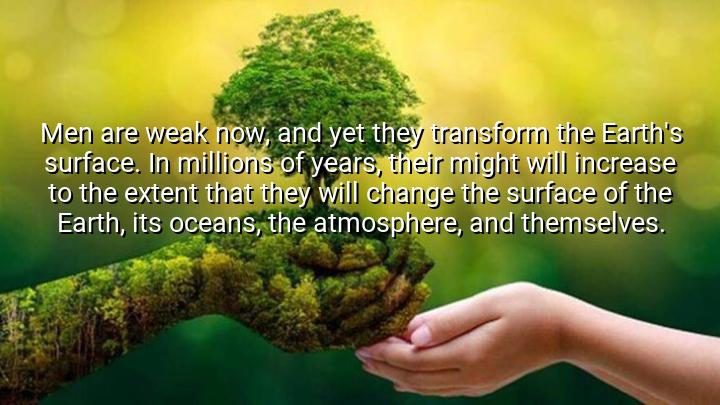




The quote "Men are weak now, and yet they transform the Earth's surface. In millions of years, their might will increase to the extent that they will change the surface of the Earth, its oceans, the atmosphere, and themselves." by Konstantin Tsiolkovsky reflects a visionary perspective on the evolution of humanity and its growing technological power. Tsiolkovsky, a pioneering Russian rocket scientist and one of the founding figures of astronautics, was known for his futuristic thinking and belief in human progress through science. This quote captures his optimistic outlook on the long-term potential of human beings to reshape the world and themselves.
Tsiolkovsky begins by acknowledging the relative weakness of humanity in the present—physically and technologically limited compared to the forces of nature. Yet even in that state, humans have already begun to transform the Earth's surface through agriculture, cities, and industry. He foresaw that over time, this influence would grow exponentially, extending to the oceans, the atmosphere, and even human nature itself through future developments in science, engineering, and possibly evolution or genetic enhancement.
The quote also touches on the concept of human potential and the Anthropocene—a term not yet coined in Tsiolkovsky's time, but one that echoes his prediction of human-driven planetary change. His vision anticipates not only environmental transformation but also philosophical and existential shifts in how humans understand and modify themselves. In many ways, it prefigures modern discussions about climate change, transhumanism, and our expanding footprint on Earth and beyond.
Ultimately, Tsiolkovsky’s quote is a mixture of awe, warning, and hope. It suggests that while we may be small and frail individually, the collective power of human innovation is immense—and growing. His words remind us of both our responsibility and our destiny as a species capable of shaping not just our world, but our very future.

AAdministratorAdministrator
Welcome, honored guests. Please leave a comment, we will respond soon